19 Parting Thoughts On The 2026 Chicago Marathon
My flight back to New York City was delayed, so I took advantage of a few extra hours at O’Hare’s gate M10 to jot down some thoughts from a fast Sunday along Lake Michigan.Here are my parting thoughts on the...
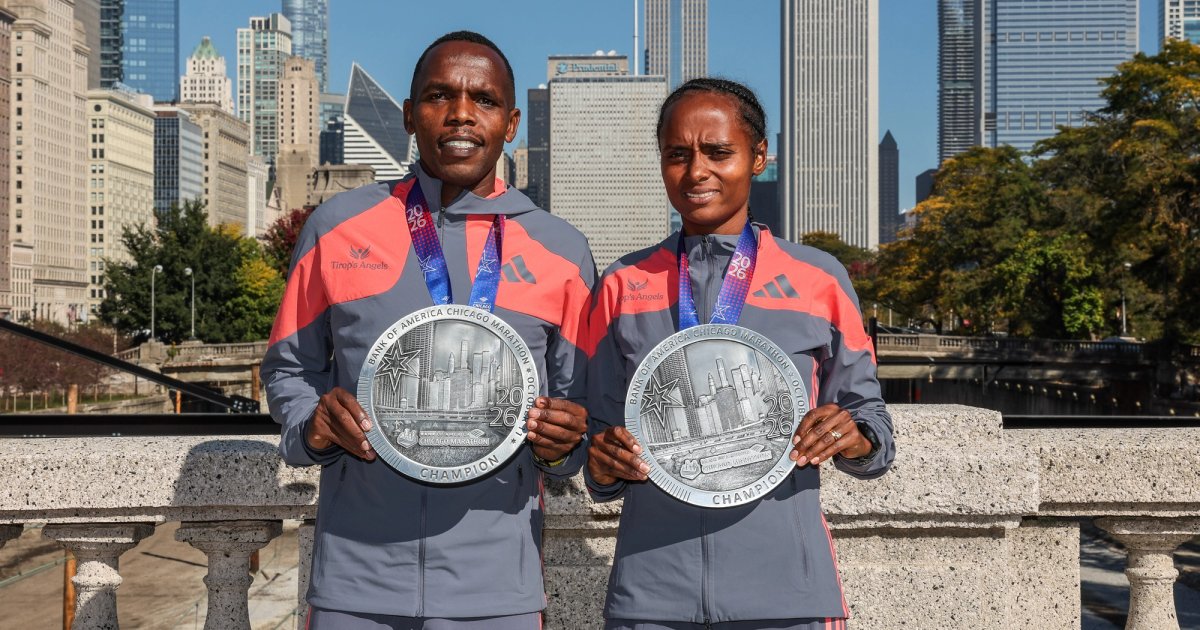
My flight back to New York City was delayed, so I took advantage of a few extra hours at O’Hare’s gate M10 to jot down some thoughts from a fast Sunday along Lake Michigan. Here are my parting thoughts on the 2026 Chicago Marathon: – After finishing second in 2025, Amos Kipruto claimed his Chicago title in 2:01:09, tying Eliud Kipchoge for No.
5 on the all-time list. Pair that with his 2:01:39 for fourth in London in April, and it’s a season that nearly belongs in the same conversation as Kelvin Kiptum’s 2023 (2:01 in London and 2:00 in Chicago). Kipruto may not have the splashy appeal of Sabastian Sawe—who arrived in the marathon as an instant home-run hitter—but his rise has been steady: through the 2:04s and 2:03s before a breakthrough 2026 at age 34.
We’ll see how New York and Valencia unfold before we think of where he slots in as one of the best overall in 2026. – Reigning champion Hawi Feysa and two-time Chicago champion and former world record holder Brigid Kosgei went out hard, covering the opening 10K in 31:04 (2:11:05 pace).
That was too aggressive for the rest of the field, leaving a Kenyan chase pack of Joan Kilimo , Sharon Lokedi , Brillian Kipkoech, and Loice Chemnung a few seconds back. Lokedi and Chemnung closed the gap by 20K, setting up an intriguing four-way battle as the leaders reached halfway in 1:06:06.
They stayed together through 25K (1:18:26), before Feysa and Lokedi split 15:50 for the next 5K to turn it into a two-woman race. Kosgei held on for third in 2:14:55, while Chemnung faded to tenth in 2:21:18. Then came the slugfest.
For roughly six miles, Feysa and Lokedi traded surges, neither able to shake the other. With a mile to go, Feysa launched one final attack, and Lokedi had no answer. Feysa broke the tape in 2:13:33 and dropped to her knees in a mix of exhilaration and exhaustion.
She moved to No. 4 on the all-time women’s marathon list, behind only Ruth Chepngetich *, Fotyen Tesfay, and Tigst Assefa . Feysa trains with the latter two under coach Gemedu Dedefo .
If there’s a better marathon training group in the world, I’d love to see someone try to make the case. – Sharon Lokedi’s marathon career is a picture of consistency. Her runner-up finish in Chicago came with a three-minute PB of 2:14:07 and moved her to No.
8 on the all-time list. Across different courses and a range of different conditions, she’s almost always in the same place near the front. Rock solid.
Rock chalk. Just as impressive was how much of the race she ran without other competitors around her. I figured U.S.
Olympian Dakotah Popehn would be the next-best American on the day, but Popehn took a more measured approach en route to a 2:24:00 PB. That left Hurley and her personal pacer, Caleb Kerr , largely on their own. They reached halfway in 1:09:50, on sub-2:20 pace.
Once Kerr peeled off, Hurley had to navigate the closing miles alone while battling rising temperatures. She slowed slightly over the final 10K but held her form to the finish. We’ve come a long way since Deena Kastor’s 2:26:58 set the American women’s debut standard in 2001.
Like Kastor was then, Hurley is 28. This could be just the start of a special marathon career. Hurley and coach Andrew Begley took a patient, long-term approach to moving up to the marathon, and Sunday showed why.
The current plan calls for just one more marathon before the 2028 Olympic Trials in St. Louis. We’ll see whether she chooses to race next spring or fall.
We had her at No. 10 on our Way Too Early 2028 U.S. Olympic Marathon Trials Power Rankings from April.
We’ll likely update them after New York, and there’s a chance she could be No. 1. – Another seventh-place finish for Clayton Young !
This time, he ran a huge PB of 2:05:23 to finish as the top American at a World Marathon Major for the first time in his career. Given the 12-centimeter hamstring tear he disclosed on The CITIUS MAG Podcast two weeks ago , I’d call this the best performance of his career. That revelation prompted plenty of doubt about whether he should race at all.
Through it all, though, Young insisted he was in shape. He was right. The injury could have offered a ready explanation for falling short of Mantz’s American record, but Young delivered on race day once again with a smart, gutsy performance.
Afterward, he said his hamstring felt good throughout and that tight glutes and a tight hip flexor were the bigger concerns. He felt smoother from roughly Mile 9 onward. – Charles Hicks rolled the dice in pursuit of the top American spot and still came away with a 2:05:35.
When Vincent Mauri (more on him soon) surged around mile nine, Hicks helped drive the chase rather than risk letting him get away. That work caught up with him when Young attacked with about three miles remaining, and Hicks couldn’t match the move. He admitted afterward in the press conference, strictly in terms of Sunday’s result, he wished he hadn’t led the chase.
But running that fast while doing so much work in warmer conditions gave him plenty of confidence. – All things considered, Mauri’s 2:06:45 for tenth was a great performance. He cramped, stopped to stretch at least twice, rejoined the group and still managed that result.
The Americans started conservatively, but Mauri’s impatience in his World Major debut got the better of him. He surged perhaps too aggressively in pursuit of the American record midway through the race, and paid for it around mile 18. Our CITIUS MAG Way Too Early 2028 U.S.
Olympic Marathon Trials Power Rankings came out before his solo 2:05:53 debut on the Glass City Marathon bike path. As with other recent marathon breakouts like Ethan Shuley , we prefer a bigger body of work and a couple of comparisons against World Marathon Major competition to really sort out where on the pecking order he falls.
Toledo’s lack of World Athletics certification (it is recognized by USATF) also fueled speculation that the course might be short or it wasn’t real, but Sunday’s performance should go a long way toward quieting those doubts. Against a true international elite field, Mauri backed up his debut and showed that the fitness we’d been watching on Strava was real.
Now, we can say he’s firmly in the conversation among America’s best marathoners. Don’t let the stops and cramps obscure how well he ran. – Galen Rupp is so back .
At 40, he ran 2:06:55 to finish as the fourth American, just 48 seconds off his lifetime best of 2:06:07 from Prague in 2018. I wasn’t out on the course enough Sunday to judge how much the humidity affected the race, but it’s wild to think he might have come even closer to his PB in better conditions.
He obliterated Elkanah Kibet’s American masters record of 2:10:02 from the 2024 U.S. Olympic Marathon Trials, taking 3:07 off the mark. Naturally, that has plenty of us old heads thinking about what Rupp could do at the 2028 Trials in St.
Louis. He’s a legitimate dark horse, even if making another Olympic team might require him to approach the fitness he was when he won bronze in 2016. There have been races where you watch him struggle and wonder why he’s still at it.
Days like Sunday give you the answer. (Also—congratulations to Galen and his wife Keara on expecting their fifth child!) – I expected more from NAZ Elite’s Aadrian Wildschutt , but this was his marathon debut, and you shouldn’t over-extrapolate from it. He was on roughly 2:05 pace through 20 miles before starting to fade, with the slowdown becoming particularly pronounced between miles 23 and 24.
He finished in 2:11:23 after a 1:08:51 second half—a 6:19 positive split. It was a tough introduction to the distance, but I’m sure he’ll take plenty of lessons from it. – On the other hand, Kieran Tuntivate put together a remarkably steady race to finish in 2:08:01.
He went through halfway in 1:03:41 and ran the second half in 1:04:20 for a 39-second positive split—the kind you’re okay with at the end of the day. – After spending the lead-up to Chicago driving his own hype train on the LetsRun message boards and declaring he would break 2:07, Patrick Cullen slipped off that pace by 20K and finished in 2:17:17.
From mile 20 onward, he was mostly running 5:50–6:13 miles. His post on Strava afterward was raw: “I’m incredibly sorry for everyone I let down and disappointed. I wanted this more than anything.
I don’t really have anything else in this life and I tried my best. I just didn’t have it today.” – Izzi Batt-Doyle took two minutes off her PB and jumped from fourth to first on the Australian marathon all-time list. Her 2:20:38 for sixth overall in shaved 46 seconds off Jessica Stenson’s national record from Valencia last December.
A huge breakthrough, capped with an Australian record. – Conner Mantz can sleep soundly with his American record intact. But the man whose record he broke, Khalid Khannouchi , is now No.
4 on the U.S. all-time list, with Young and Hicks both moving ahead of him on Sunday (on record-eligible courses). – Since we love keeping tabs on 2028 U.S. Olympic Marathon Trials qualifiers, Shuaib Aljabaly was the lone new qualifier on the men’s side, running 2:10:04 for 19th overall in his marathon debut.
On the women’s side, 11 runners broke 2:37:00, with four earning new qualifiers: Emma Grace Hurley (2:20:47), Kelby Laughner (2:35:41), Alli Sefanov (2:35:50), and Sarah Chandler (2:36:06). – We were also treated to some cameos by 2016 Olympic medalists Matthew Centrowitz (2:24:11) and Evan Jager (2:32:43).
If you haven’t watched this video produced by the Tracksmith about Centrowitz , take a few minutes to do so. – Congrats to 2016 World Series champion, Chicago Cubs legend, and former New York Yankee Anthony Rizzo on his marathon finish in 5:31:57. His former teammate Jake Arrieta ran 4:27:13.
– We try to give the Chicago Marathon broadcast some grace because it’s primarily handled by NBC Chicago’s local crew, but this was another major disappointment. In past years, we barely got to see the leading American woman, so having a dedicated moto following Hurley felt like progress.
Yet we didn’t see the leading American man until almost an hour into the race. The broadcasters cited a camera malfunction, which explains the gap but doesn’t make it any less frustrating. Balancing coverage of the running and wheelchair races is always a challenge, especially on a day when Catherine Debrunner set a women’s wheelchair world record of 1:33:16.
But cutting to full-screen interviews while athletes are racing and making moves is an avoidable mistake. We know we have the picture-in-picture layouts available because we occasionally see them! The most maddening example came when Feysa and Lokedi were locked in a terrific battle, and we were forced to listen to Abbott’s Divisional VP of Global Brand Strategy & Innovation.
C’mon. There’s a time for interviews. That wasn’t it.
I get my hopes up every year, and yet Chicago keeps delivering one of the most frustrating marathon broadcasts to watch. – The good news: there’s reason to believe the broadcast could improve. USATF is promising more cameras for next year’s Chicago Marathon, which will host the 2027 USATF Marathon Championships.
As announced last week, 20 American men and 20 American women will compete for national titles, with prize money through tenth place in both races. Chicago will also expand its High Performance Program to 300 participants, creating more opportunities for Americans chasing the 2028 Olympic Marathon Trials standards.
That already positions Chicago to be the most compelling U.S. Major next year. But here’s an informed guess about what could raise the stakes even further: Olympic eligibility.
We’re still waiting for World Athletics and the International Olympic Committee to announce the qualifying window and standards for LA 2028. My guess is that the standards will be close to those for the 2027 World Championships: 2:06:00 for men and 2:23:20 for women. I also wouldn’t count on a repeat of the quota reallocation mechanism that helped the U.S. field a full three-man team in Paris.
Depending on the qualification standards, athletes could have several routes to eligibility: running the standard before the Trials, earning a top-5 finish at a Platinum Label race, hitting the time in St. Louis, or securing a high enough world ranking before the LA qualifying window closes.
Boston offers the top-5 option. But Boston’s course doesn’t count for the time standard, and cracking the top five depends heavily on the international field. I could see two New York City Marathons falling within the LA qualifying window (if World Athletics and the IOC go with Nov.
1st, 2026 as the start date), which could offer another top-five pathway. New York’s course is also eligible for the time standard, but it’s harder because of the bridges and hills. Americans could also head overseas in the spring to chase a qualifying time, though we don’t usually see a large contingent take that route.
That creates a tricky scheduling decision. Many Americans get paid well to run Boston, and money talks. They could have an excellent race there without securing Olympic eligibility, leaving their fall marathon as a crucial opportunity to get the standard before the Trials. (I hope you’re still following me.) Since the start of 2025, only four American men have broken 2:06 on a record-eligible course: Conner Mantz, Zouhair Talbi , Clayton Young, and Charles Hicks.
On the women’s side, just three have broken 2:23:20: Emma Grace Hurley, Fiona O’Keeffe , and Erika Kemp . Those performances show we have athletes capable of hitting those times, with others close behind. But with the qualifying window still unopened, they’ll need to do it again when it counts.
That makes the 2027 race calendar consequential. Choose Boston in the spring without securing eligibility, and the pressure could be on in the fall. An injury, an off day or bad weather could complicate everything.
Think about how closely everyone was watching the forecast for Chicago this weekend. We love the Trials because the stakes are so high. Next year’s Chicago Marathon could offer its own version of that drama with national titles on the line, a deep American field and, potentially, the clock shaping who actually gets a shot at LA.
The flight is finally boarding. NEW YORK IS IN THREE WEEKS. THIS TIME, I’M RUNNING.
Keep up with all things track and field by following us across Instagram , X , Threads , and YouTube . Catch the latest episodes of the CITIUS MAG Podcast on Spotify and Apple Podcasts . For more, subscribe to The Lap Count and CITIUS MAG Newsletter for the top running news delivered straight to your inbox.
Article text via FreeNewsAPI. Rights remain with Citius Mag.
Read on publisher site → Opens Citius Mag in a new tab