ADGRG1 Receptor Cleavage Simulated With 54-qubit Quantum Processor
A 54-qubit IQM quantum processor is at the heart of a new simulation that models a biologically important process: a protein cutting itself in two. Researchers from QMatter, the Technical University of...
A 54-qubit IQM quantum processor is at the heart of a new simulation that models a biologically important process: a protein cutting itself in two. Researchers from QMatter, the Technical University of Munich, University College London , Leibniz Supercomputing Centre, Ludwig-Maximilians-Universität München, NVIDIA , and IQM Quantum Computers coupled the quantum processor with up to 1,200 NVIDIA H100 GPUs to model the autoproteolysis of ADGRG1, an adhesion G-protein-coupled receptor linked to both brain development disorders and aggressive breast cancer.
Understanding precisely how this cleavage happens could provide a basis for targeting this receptor family therapeutically, as roughly one-third of approved medicines act on GPCRs, yet no adhesion GPCR has been successfully targeted by an approved drug. ADGRG1 Autoproteolysis: Biological Significance & Prior Challenges High levels of ADGRG1, an adhesion G-protein-coupled receptor, have recently been linked to aggressive triple-negative breast cancer, adding urgency to efforts to understand its unusual autoproteolysis process, where the protein cleaves itself without external enzymatic assistance.
This self-cutting occurs at a specific site within the ADGRG1’s GAIN domain, a characteristic shared by most adhesion GPCRs, yet remains poorly understood at a mechanistic level. Despite G-protein-coupled receptors constituting roughly one-third of approved medicines, no approved drug currently targets an adhesion GPCR, highlighting a significant gap in pharmaceutical intervention.
Figure 4: Energy profile along the autoproteolysis pathway at different levels of theory. — Source: qmatter.xyz Researchers modeled this autoproteolysis within a biologically relevant environment, the membrane of the endoplasmic reticulum, to account for the receptor’s full biochemical context.
A fully quantum-mechanical treatment of the million atoms involved is currently beyond the capabilities of any existing computer, necessitating a combined approach. The study, titled “Multiscale Quantum-Classical Simulation of Protein Autoproteolysis in a Million-Atom Membrane Environment,” addresses a critical knowledge gap in a receptor family implicated in diverse diseases.
Mutations in ADGRG1, for example, cause bilateral frontoparietal polymicrogyria, a rare disorder affecting brain development, while its role in platelet function and blood clotting further highlights its biological importance. The work aims to provide a foundation for eventually targeting this receptor family with therapeutic interventions, a goal that has eluded researchers for years.
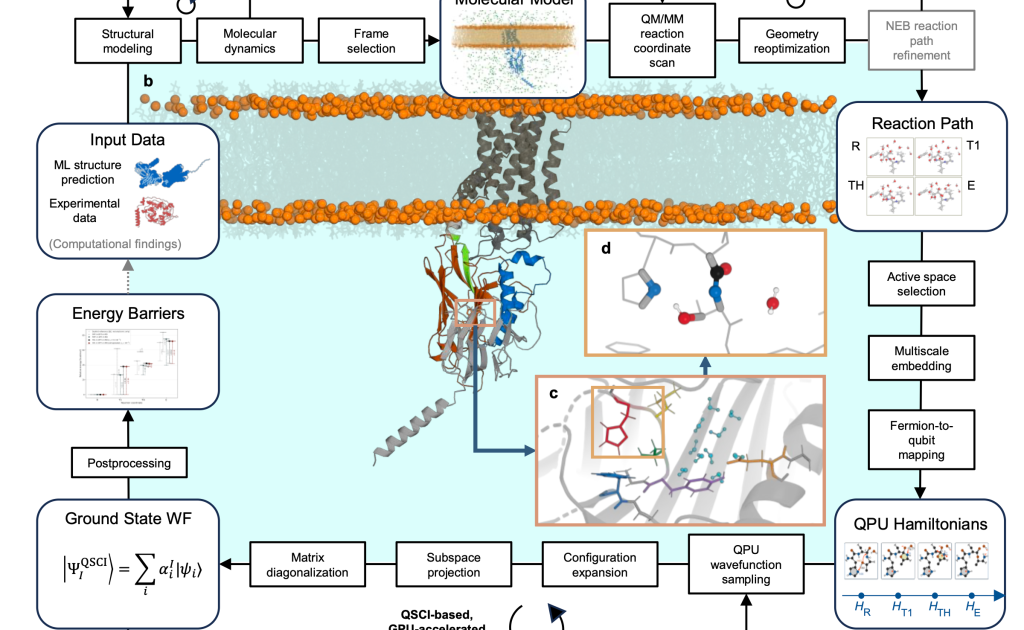
Multiscale Pipeline: Coupling Quantum and Classical Simulations The simulation pipeline’s modular design allows for future improvements in quantum algorithms and embedding schemes without requiring a complete overhaul of the workflow. Each stage exchanges well-defined data, including geometries, Hamiltonians, quantum circuits and measurement data, facilitating the integration of more advanced techniques as they become available.
This approach contrasts with monolithic simulation strategies, offering greater flexibility and adaptability for ongoing research. The team sized the core quantum problem to fit the capabilities of the 54-qubit IQM processor, focusing on 26 electrons in 26 orbitals mapped onto 52 qubits.
Classical computations supporting the quantum calculations were performed on Wolpertinger, a high-performance computing cluster within the BEAST testbed at the Leibniz Supercomputing Centre. Wolpertinger is directly connected to Euro-Q-Exa, the 54-qubit IQM quantum computer, enabling smooth data transfer and orchestration of the hybrid simulation.
Around one million measurements were collected per reaction structure, managed through NVIDIA CUDA-Q , an open platform designed for hybrid quantum-classical supercomputing, the company says. This integration of hardware and software demonstrates a functional pipeline for tackling complex biomolecular problems.
The quantum-classical approach successfully resolved a disagreement in previous modeling of ADGRG1 autoproteolysis, recovering a proposed ordering of events and lowering the overall energy barrier from 55.4 to 51.9 kcal/mol. The most significant improvement occurred in the initial proton-transfer and bond-forming step, an area known to challenge approximate classical methods.
Comparing the quantum pipeline’s results to a classical benchmark, the team found barriers of 25.9, 28.3, and 52.1 kcal/mol using their quantum simulation, closely matching the 25.5, 27.5, and 51.9 kcal/mol values obtained from extrapolated heat-bath configuration interaction. This integration is not merely theoretical; the team applied it to a specific biological question, understanding how ADGRG1 cleaves its own backbone, according to IQM.
“Quantum Computing Within Million-Atom Multiscale Simulations, Orchestrated with NVIDIA CUDA-Q,” details the methodology and results of this work, published earlier this year. Quantum-Selected Configuration Interaction Validates Energy Barriers The quantum calculation refined energy barrier predictions for ADGRG1 autoproteolysis, resolving discrepancies found in earlier computational work.
Using quantum-selected configuration interaction (QSCI), the team achieved a correlated treatment that lowered the overall energy barrier to 51.9 kcal/mol, a value closely aligned with the 51.9 kcal/mol obtained from extrapolated heat-bath configuration interaction, the company says.
This improvement stems from a more accurate depiction of electron rearrangement during bond breaking and formation, processes critically influenced by the surrounding protein, membrane and solvent. Previous simulations of adhesion G-protein-coupled receptor (aGPCR) autoproteolysis relied on simplified models, often isolating receptor fragments in water and omitting the key membrane-spanning region.
The iterative version of QSCI developed for this work addresses this limitation by feeding information from classical solutions back into subsequent sampling, focusing on configurations previously overlooked. This approach, coupled with the use of a 54-qubit IQM quantum processor and up to 1,200 NVIDIA H100 GPUs, allowed for a more comprehensive assessment of the energy landscape governing the cleavage process.
This consistency extends to broader biological relevance. Despite employing a more realistic model and studying a different receptor, the results align with earlier simulations of the rat receptor ADGRL1, supporting the concept of autoproteolysis as a singular cleavage event. The researchers state that “Agreement between independently constructed models strengthens confidence that the underlying chemistry is captured,” highlighting the validation offered by this combined quantum-classical approach.
More like this Stay current See today’s quantum computing news on Quantum Zeitgeist for the latest breakthroughs in qubits, hardware, algorithms, and industry deals.
Article text via FreeNewsAPI. Rights remain with Quantum Zeitgeist.
Read on publisher site → Opens Quantum Zeitgeist in a new tab