Astronomers Discover Green, Pink and Purple White Dwarfs
Astronomers uncover the surprising colours of white dwarfs, revealing how extreme stellar atmospheres transform the light they emit.Astronomers have found that some white dwarf stars could appear green, pink,...
Astronomers uncover the surprising colours of white dwarfs, revealing how extreme stellar atmospheres transform the light they emit. A stronomers have found that some white dwarf stars could appear green, pink, purple, yellow or cyan to the human eye, revealing a surprising range of colours among the remnants of stars that have reached the end of their normal lives.
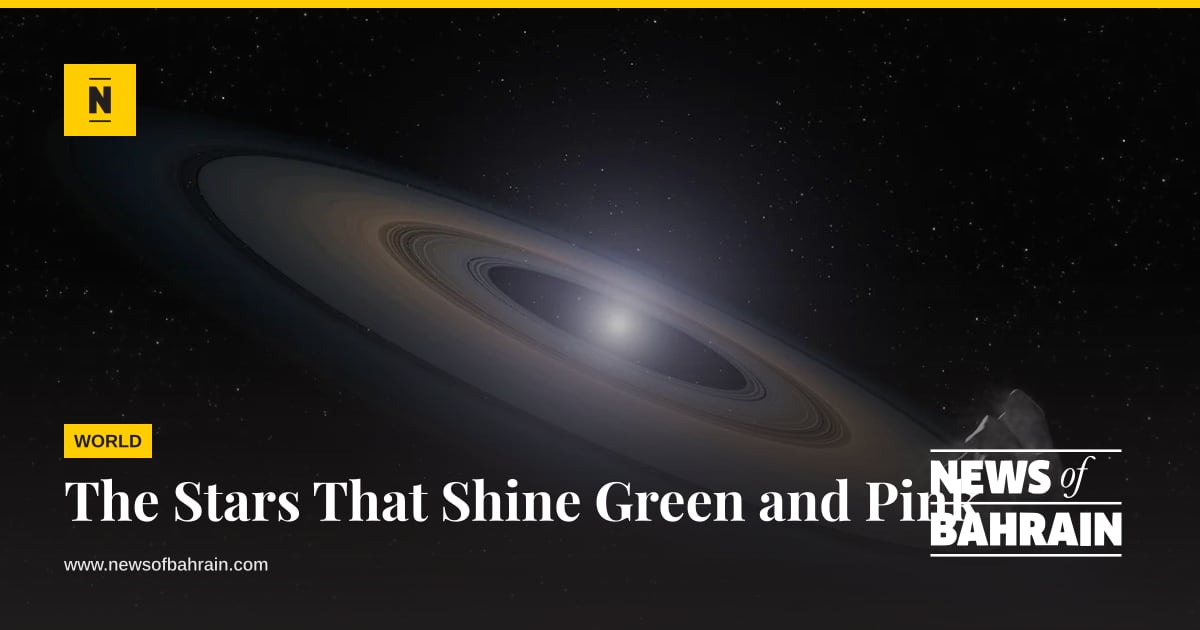
Artist’s impression of WD J1330+6435, a white dwarf whose calculated colour is chartreuse green The findings come from a study published on 15 October 2026 in RAS Techniques and Instruments . Led by Mark Hollands of the University of Warwick, the research examined how temperature and atmospheric composition affect the colours of white dwarfs.
Rather than photographing the stars in these colours, the researchers used stellar spectra and models of human colour vision to calculate how the objects would appear if viewed close enough for their discs to be resolved. The study found that although most white dwarfs appear white, certain objects have unusual colours because their atmospheres contain elements that change the way they absorb light.
Why some white dwarfs have unusual colours White dwarfs are the dense remnants left behind when stars such as our Sun exhaust their nuclear fuel and shed their outer layers. Their atmospheres can be extraordinarily dense. In cooler white dwarfs, trace elements such as carbon, calcium and sodium can affect the absorption of light across a wider range of wavelengths than they would under less extreme conditions.
This changes the light reaching an observer and can produce colours that differ from those expected from temperature alone. The researchers found that some carbon-rich white dwarfs can appear pink or purple. Objects whose atmospheres have accumulated material from disrupted planetary bodies can appear yellow or green, while certain cooler white dwarfs with mixed hydrogen and helium atmospheres can appear cyan.
The white dwarf that appears green One of the most striking examples is WD J1330+6435, a white dwarf with an estimated temperature of around 4,000 degrees Celsius. The star has accumulated rocky material from its former planetary system, enriching its atmosphere with elements including calcium, lithium and sodium.
An artist's impression of a white dwarf accreting rocky debris from its surviving planetary system. Under the extreme conditions in its atmosphere, sodium absorbs light across a broad range of wavelengths, including much of the yellow, orange and red portions of the visible spectrum.
The researchers' calculations consequently produce a chartreuse-green appearance. The researchers describe the object as the first credibly reported example of a star that would appear green to the human eye. However, this colour is derived from scientific modelling rather than a direct photograph showing the star's surface in green.
A nearby white dwarf with a pink appearance Another example is WD J1011+2845, a white dwarf approximately 48 light-years from Earth. In this object, convection brings carbon from deeper layers towards the surface, where carbon molecules affect the spectrum of the emitted light. The resulting calculations indicate a salmon-pink appearance.
These examples demonstrate that a star's chemical composition can be just as important as its temperature when determining its perceived colour. Most white dwarfs are still white Despite the unusual examples, colourful white dwarfs are not the norm. The researchers examined a volume-limited sample of 152 white dwarfs within 20 parsecs of the Sun, equivalent to approximately 65 light-years.
Five objects in the sample displayed unusual colours: two yellow and three pink. For the remaining 147 objects, the researchers found a median correlated colour temperature of approximately 6,800 kelvin, consistent with a colour perceived as white. The findings also help explain why some astronomical surveys contain a disproportionate number of hotter, bluer white dwarfs.
These objects are brighter and can be detected at greater distances, making them more likely to appear in surveys selected according to brightness. How astronomers calculated the colours The team used stellar spectra, which record how much light an object emits at different wavelengths.
They then applied models of human colour vision to estimate the colours that the stars' light would produce. This approach allows researchers to investigate stellar colours even when the objects are too distant and faint for their discs to be resolved in direct observations. The resulting images are scientific visualisations based on the models, not ordinary telescope photographs of the stars' surfaces.
The research offers a new perspective on the diversity of white dwarfs and demonstrates how their atmospheric chemistry can influence the light they emit. It also highlights how measurements of starlight can reveal details that cannot be established from a conventional image alone.
Article text via FreeNewsAPI. Rights remain with News of Bahrain.
Read on publisher site → Opens News of Bahrain in a new tab