At the Pinault Collection: An Arresting History of Photography
Now open at the Bourse de Commerce, Paris, Remember Me provides a whistle-stop tour of the history of photography – but it’s the show’s less recognisable, more conceptual works that serve to celebrate the medium’s potential to subvert
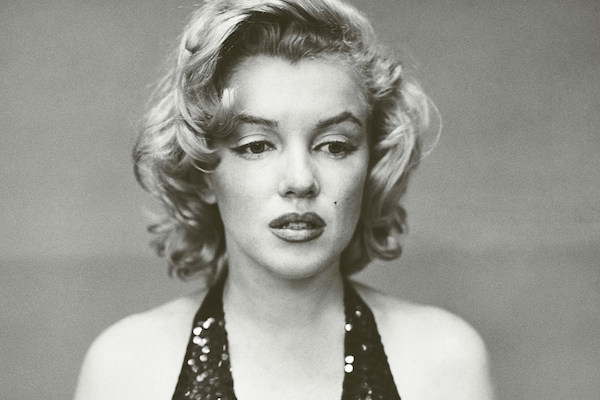
Dazed media sites Richard Avedon, Marilyn Monroe, 1957 Courtesy of the Bourse de Commerce — Pinault Collection Now open at the Bourse de Commerce, Paris, Remember Me provides a whistle-stop tour of the history of photography – but it’s the show’s less recognisable, more conceptual works that serve to celebrate the medium’s potential to subvert October 08, 2026 At the centre of Remember Me , a new exhibition at the Bourse de Commerce in Paris, is a vast installation by Barbara Kruger.
Titled The History of Tears, the American artist has transformed the museum’s immense rotunda space into an extraordinarily immersive installation comprising graphic text and video in her signature colour palette of black, red and white. Plastered with seminal quotes from literary works including George Orwell’s 1984, Aimé Césaire’s Journal of a Homecoming and Roland Barthes’s A Lover’s Discourse, the work is a powerful meditation on surveillance, the self, and society.
An uncanny video titled Power, Pleasure, Desire, Disgust sees a series of everyday Americans talking freely to camera about their emotions, providing an unsettling soundscape that reverberates throughout the show. The exhibition takes its title from another of Kruger’s works, Remember Me, encapsulating photography’s capacity to enshrine and preserve people and moments long gone.
Organised to align with photography’s bicentenary – the earliest surviving photograph, View from the Window at Le Gras, was created in 1827 by Nicéphore Niépce – Remember Me takes a whistle stop tour through the history of the medium, from early photographic experiments like Gustave Le Gray’s sublime sepia seascapes from the late 1850s to modern-day portraiture by Tyler Mitchell shot as recently as 2024.
Curated by Matthieu Humery, Advisor for Photography at the Pinault Collection, the exhibition comprises a dizzying 700 works by more than 70 photographers, including Irving Penn , Richard Avedon , Cindy Sherman , Nan Goldin , Wolfgang Tillmans , Francesca Woodman, and many more. All are drawn from the private collection of François Pinault, a billionaire French businessman who has amassed one of the world’s largest collections of contemporary art, with over 10,000 pieces collected over the past 50 years.
Five years ago he opened the doors to the Bourse de Commerce, a contemporary art museum built in the former French stock exchange to showcase his collection to the public via a series of rotating exhibitions. Irving Penn, Cuzco Children, 1948 Courtesy of the Bourse de Commerce — Pinault Collection After encountering Kruger’s installation, visitors are led into another exhibition-within-an-exhibition, The World According to Penn.
In one vast room, a constellation of almost 450 of Irving Penn ’s photographs are hung on the walls from floor to ceiling, reaching well beyond eye level. Comprising the American photographer’s sumptuous still lifes, nudes, studio portraiture and editorial fashion work taken from the 1940s to the early 2000s, this room showcases the astonishing breadth of Penn’s work, along with his keen eye for beauty and character.
Continue reading
Watch a short ad to unlock the full article
The rest stays locked if you skip or close the ad early.
Penn’s photographs reappear throughout the rest of the exhibition, including his remarkably tender 1948 portrait Cuzco Children, which captures two barefoot Peruvian children in threadbare traditional garb. It’s an emotionally charged image that speaks to the flimsy divide between childhood and adulthood, and one of the best in the show.
The rest of the exhibition unfolds thematically, not chronologically, with photographers grouped together in sections exploring the nude, portraiture, the sea, abstraction, composition and more. “This celebration has been constructed like a fugue: a free-ranging, non-chronological stroll through all genres of the medium,” says curator Matthieu Humery.
“The goal is to narrate the history of photography in a non-didactic manner.” Many of the most iconic photographs from history are on show here, from Robert Doisneau’s unabashedly romantic The Kiss by the Hôtel de Ville to Man Ray’s surrealist masterpiece Noire et Blanche , Edward Steichen’s veiled portrait of a Gloria Swanson for Vogue, Dora Maar ’s spiderwebbed photomontage The Years Lie in Wait for You, and Helmut Newton ’s monumental Big Nudes, which were originally inspired by police photographs of the far-left terrorist German terrorist organisation Red Army Faction.
Helmut Newton, Big Nude III, 1980 Courtesy of the Bourse de Commerce — Pinault Collection But it’s the show’s less recognisable, more conceptual works that are most arresting. Hiroshi Sugimoto ’s ghostly, monochromatic seascapes speak more to the painterly abstract colour planes of Rothko than to photography’s supposed mission to capture reality.
Concorde , a purple-tinted Wolfgang Tillmans series, captures the supersonic jet plane disappearing into the sky, a utopian 20th-century relic of technological idealism since gone wrong. Another series, From the Los Ebanos Crossing by Zoe Leonard, speaks to the invasive nature of surveillance, with 34 prosaic images capturing helicopters circling overhead on the border between Mexico and the United States.
Further on, a handful of poignant photographs masterfully address violence and its aftermath. There’s Lee Miller’s intensely humane 1944 photograph of a forlorn French woman who has had her hair shaved off as punishment for liaising with the German occupying forces – a common public humiliation ritual at the time.
In 1971, as the war raged on in Vietnam, Richard Avedon travelled to Saigon to document the war’s consequences on the civilian population. The result is Napalm Victims, an unwavering series capturing the mangled flesh, faces and limbs of four female survivors. The year before, he photographed Andy Warhol after he was shot in 1968 by the radical feminist Valerie Solanas.
Instead of posing shirtless, as he did in Alice Neel’s painting , Warhol wears a black leather jacket, which he pushes back – along with his surgical corset – to reveal the damage on his torso. It’s a soft, sensual series of images that offer a rare glimpse beyond Warhol’s buttoned-up persona.
Tyler Mitchell, An Embrace, 2024 Courtesy of the Bourse de Commerce — Pinault Collection The show ends with Ma Dernière Photographie (My First Photograph) by Man Ray, a work that is, in fact, not a photograph. Created in 1929, this simple work is constructed using a black rectangle on cardboard, playfully subverting viewers’ expectations about what constitutes a photograph.
It’s the perfect closing statement for a show that celebrates the medium’s potential to subvert, innovate, and shape news ways of seeing the world around us. Remember Me is on show at the Bourse de Commerce in Paris until 18 January 2027.
Article text via FreeNewsAPI. Rights remain with AnOther Magazine.
Read on publisher site → Opens AnOther Magazine in a new tab