Chandra points to a compact companion of star AT 2016blu — Space.com
Observations by NASA’s Chandra X-ray Observatory indicate that the recurring bright outbursts of the massive star AT 2016blu in the galaxy NGC 4559 may be explained by an invisible compact companion. It may...
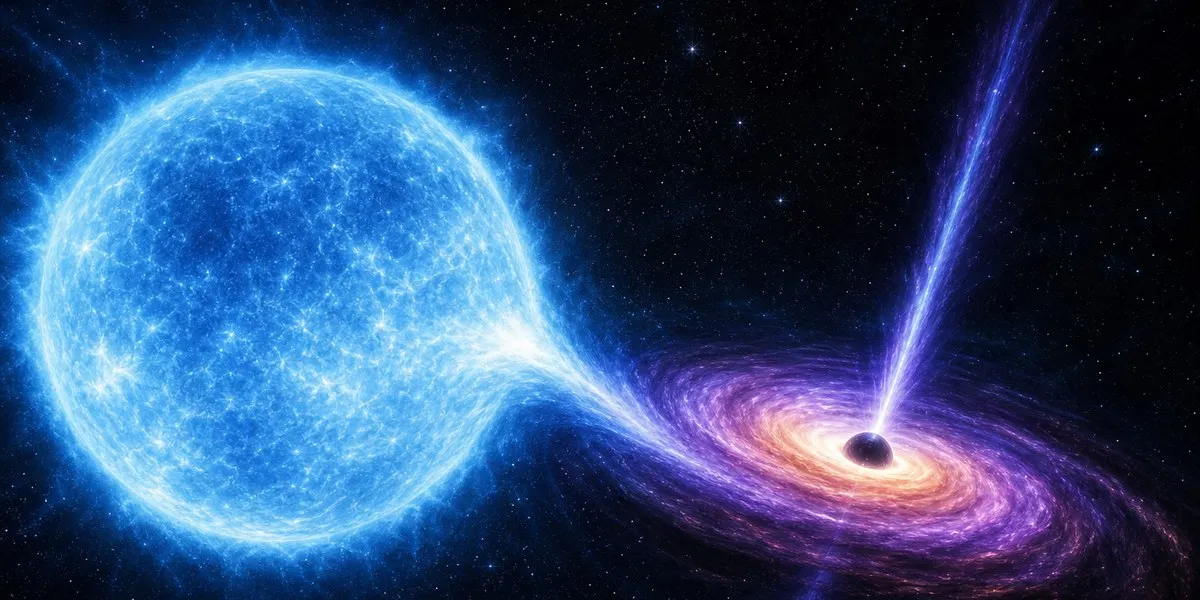
Observations by NASA’s Chandra X-ray Observatory indicate that the recurring bright outbursts of the massive star AT 2016blu in the galaxy NGC 4559 may be explained by an invisible compact companion. It may be a stellar-mass black hole or a neutron star, Space.com reports . AT 2016blu is located on the outskirts of the spiral galaxy NGC 4559, about 25 million light-years from Earth, in the constellation Coma Berenices.
On January 11, 2012, its outburst was initially mistaken for a supernova explosion. However, after the light faded, the star remained visible, and 27 such outbursts have been recorded in the system, recurring approximately every 113 days. An X-ray signal during an outburst AT 2016blu belongs to the class of luminous blue variables — very massive and luminous stars that are unstable and periodically eject matter from their outer layers.
In March 2026, Chandra was directed at the object during another outburst. The observatory detected powerful X-ray radiation associated with the visible outburst. More current news is available on the UA.News Telegram channel Telegram .
According to the researchers’ estimate, the compact companion moves in an elliptical orbit with a period of 113 days. During its closest approach, its gravity pulls matter away from the luminous blue variable. This matter forms a hot accretion disk around the black hole or neutron star, which emits X-rays.
Why the system resembles a supernova The X-ray radiation heats a dense cloud of gas that the star ejected earlier. The heated gas shines brightly in the visible range, making the phenomenon outwardly resemble a supernova explosion. The study’s authors also noted that AT 2016blu is bright enough to be classified as an ultraluminous X-ray source.
A description of the observations was published in The Astrophysical Journal.
Article text via FreeNewsAPI. Rights remain with UA.NEWS.
Read on publisher site → Opens UA.NEWS in a new tab