Harvard's Semeghini Group Builds A Two-element Quantum Platform
Skip to content Researchers at Harvard University have demonstrated a dual-species quantum computing platform using Rubidium-87 and Ytterbium-171, achieving a coherence time of 14.6(8)...
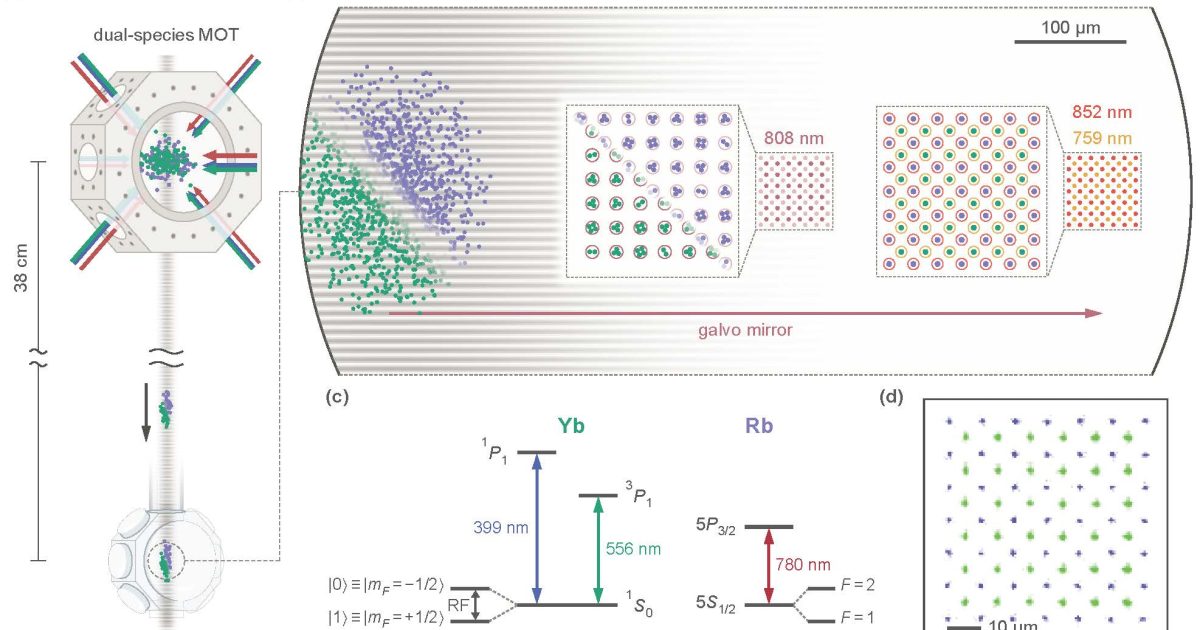
Skip to content Researchers at Harvard University have demonstrated a dual-species quantum computing platform using Rubidium-87 and Ytterbium-171 , achieving a coherence time of 14.6(8) seconds for Ytterbium-171 qubits while simultaneously cooling and trapping Rubidium-87 atoms. The Semeghini group’s system uses optical lattice transport and multiple wavelengths of optical tweezers to continuously reload both elements, a hardware innovation differentiating it from approaches focused solely on increasing qubit count.
This combination uses Rubidium’s simple atomic structure alongside Ytterbium-171’s long-lived nuclear spin for extended quantum information storage, anticipating a use case where Rubidium atoms serve as rapidly replaced ancilla qubits alongside Ytterbium data qubits. Rb-87 and Yb-171 Dual-Species Platform for Quantum Computing Rubidium-87’s well-understood, hydrogen-like atomic structure simplifies initial cooling and trapping procedures, while Ytterbium-171’s long-lived nuclear spin provides a robust storage medium for quantum information.
The platform’s architecture begins with a dual-species Magneto Optical Trap, where both Rubidium and Ytterbium atoms are initially cooled and trapped before being transported to a glass cell containing the qubit register. Optical tweezers then selectively extract atoms from the transport lattice and position them within element-specific trapping sites.
Wavelengths are carefully tuned to both cool the atoms and define the quantum states used to encode information in the Ytterbium-171 qubits. An averaged fluorescence image visually confirms the successful trapping of both purple Rubidium and green Ytterbium atoms, showing the co-location of the two species.
A pre-print detailing the findings is forthcoming on ArXiv. More like this Stay current See today’s quantum computing news on Quantum Zeitgeist for the latest breakthroughs in qubits, hardware, algorithms, and industry deals. Rusty Flint Rusty is a quantum science nerd.
He's been into academic science all his life, but spent his formative years doing less academic things. Now he turns his attention to write about his passion, the quantum realm. He loves all things Quantum Physics especially.
Rusty likes the more esoteric side of Quantum Computing and the Quantum world. Everything from Quantum Entanglement to Quantum Physics. Rusty thinks that we are in the 1950s quantum equivalent of the classical computing world.
While other quantum journalists focus on IBM's latest chip or which startup just raised $50 million, Rusty's over here writing 3,000-word deep dives on whether quantum entanglement might explain why you sometimes think about someone right before they text you. (Spoiler: it doesn't, but the exploration is fascinating)
Article text via FreeNewsAPI. Rights remain with Quantum Zeitgeist.
Read on publisher site → Opens Quantum Zeitgeist in a new tab