L3Harris Wins NASA Contract for All-Glass LISA Test Telescope
L3Harris Technologies has been selected by NASA to design, assemble, integrate and test an all-glass telescope for the Laser Interferometer Space Antenna (LISA) mission, the company announced on October 8, 2026. In an article published the same day, NASA identified the unit as the Engineering Test Unit and described it as a final step toward [...]
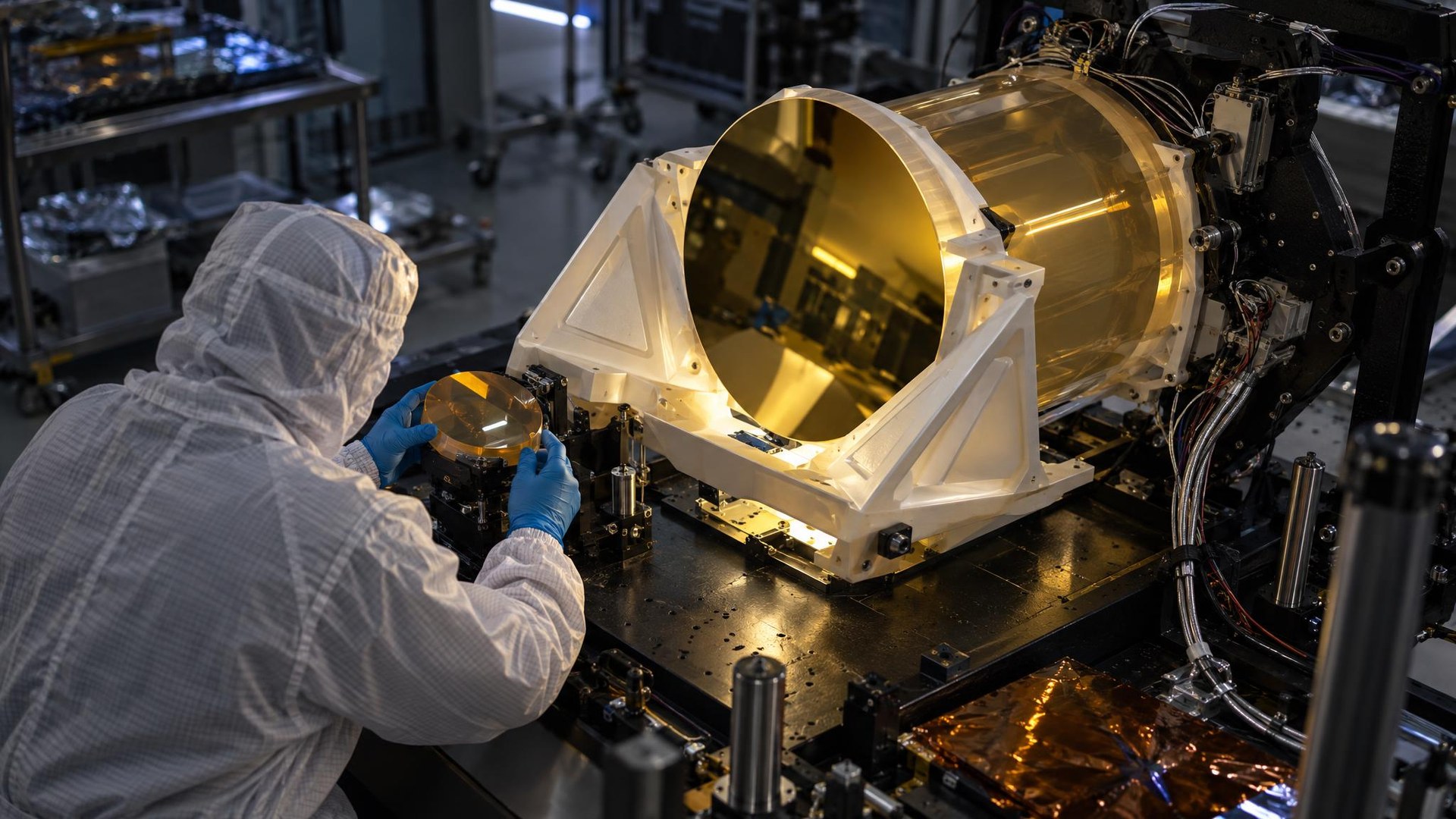
L3Harris Technologies ( LHX ) has been selected by NASA to design, assemble, integrate and test an all-glass telescope for the Laser Interferometer Space Antenna (LISA) mission, the company announced on October 8, 2026. In an article published the same day, NASA identified the unit as the Engineering Test Unit and described it as a final step toward the future production of flight hardware for the European Space Agency-led gravitational wave observatory.
“We’ve put the prototype through rigorous testing, and we’re bringing everything we’ve learned into this new telescope,” said Ritva Keski-Kuha, lead for the LISA Telescope program at NASA’s Goddard Space Flight Center. “This will be our last pre-flight unit and our first optical telescope delivery to ESA.” NASA stated that the team delivered a structural model of the telescope made from metal instead of glass in June 2026.
According to the L3Harris announcement, the mission aims to detect gravitational waves in space by measuring distance changes between satellites using laser beams, supporting the study of black holes, colliding stars and space-time. The mission will deploy three satellites in a heliocentric orbit, forming a triangular constellation spanning 2.5 million kilometers to measure distance changes smaller than the width of a single atom.
Each satellite will carry two L3Harris telescopes capable of transmitting and receiving precision laser beams with the support of ceramic glass. “LISA will open a new window into the universe that ground-based observatories cannot access,” said Jeff Hanke, President, Space Systems, Space & Mission Systems, L3Harris.
“By listening to the low-frequency ripples in space-time across millions of kilometers, LISA allows the study of massive, distant and rare cosmic events that are otherwise invisible.” All-Glass Telescope Design Each telescope will be made entirely of an amber-colored ceramic-glass composite called Zerodur, which NASA stated is widely used in high-precision applications because it resists changes in shape across a wide range of temperatures.
In NASA’s October 2024 article on the program’s prototype telescope , the agency stated that the Zerodur material is manufactured by Schott in Mainz, Germany, and that the primary mirror is coated in gold to better reflect the infrared lasers and to reduce heat loss from a surface exposed to cold space, since the telescope operates best near room temperature.
NASA’s LISA contributions page describes the telescopes as afocal beam expanders with pupil relays optimized to minimize the cross-coupling of angular jitter into pathlength. Each pair of telescopes is in series with the interferometric measurement path between the LISA test masses, and the optical pathlength through the telescope must be extremely stable so that distortions of the telescope do not mask gravitational wave signals, the agency stated.
The primary mirror has a diameter of roughly 30 centimeters, and NASA identified L3Harris as its partner on the telescopes. According to L3Harris’s LISA capability page , the design requirements include extreme resiliency to thermal changes because of the telescope’s proximity to the Sun, and the company’s engineers must design the telescope without metal or composite materials.
Continue reading
Watch a short ad to unlock the full article
The rest stays locked if you skip or close the ad early.
Twin telescopes aboard each spacecraft will both transmit and receive infrared laser beams to track their companions, and NASA is supplying all six telescopes to the mission, the agency said in its 2024 prototype article. Mission Framework and Prior Telescope Work ESA leads LISA, which was selected as the third large mission of the agency’s Cosmic Vision 2015-2025 program.
In ESA’s mission approval announcement , the agency stated that its Science Programme Committee approved the mission in a step formally called adoption, giving the go-ahead to build the instruments and spacecraft, with that work to start in January 2025 once a European industrial contractor had been chosen.
The three spacecraft will trail Earth in its orbit around the Sun, forming an equilateral triangle with sides of 2.5 million kilometers, more than six times the Earth-Moon distance, and the launch of the three spacecraft is planned for 2035 on an Ariane 6 rocket. NASA states the mission is slated for launch in the mid-2030s.
ESA stated it will provide the spacecraft, launch, mission operations and data handling. The free-falling test masses are provided by Italy and Switzerland; the picometre-accuracy systems to detect the interferometric signal are provided by Germany, the United Kingdom, France, the Netherlands, Belgium, Poland and the Czech Republic; and the Science Diagnostics Subsystem is provided by Spain.
NASA will provide the ultra-stable lasers, the 30-centimeter telescopes to collect their light and the sources of ultraviolet light used to discharge the test masses, according to ESA. NASA’s own account lists its additional contributions as the laser system, devices to manage the buildup of electric charge on the proof masses, data analysis for identifying and characterizing individual gravitational wave sources, and additional scientific and engineering expertise.
NASA’s contributions page also identifies the University of Florida as its partner on an improved charge management system based on ultraviolet LEDs. Each of the three LISA spacecraft contains a free-floating gold-platinum cube called a proof mass, and the spacecraft will fly around the cube and manage its environment so the cube falls through space only under the influence of gravity, NASA stated.
According to the agency, gravitational waves were predicted by Albert Einstein’s 1916 general theory of relativity and first detected by ground-based observatories in 2015, and ESA’s LISA Pathfinder mission showed in 2016 that non-gravitational forces on the proof masses could be reduced to the level needed for gravitational wave detection.
Ira Thorpe, the NASA project scientist for the mission at Goddard, said the changes LISA will measure are smaller than the width of a helium atom, and that through them LISA will reveal a sea of low-frequency gravitational waves that cannot currently be detected through facilities on Earth.
He said the mission will be able to detect mergers of monster black holes billions of light-years away, map compact pairs of white dwarfs, neutron stars and stellar-mass black holes in our own cosmic backyard, and perhaps provide new insights into gravity itself. The new telescope follows L3Harris’s earlier work on the program.
In a NASA contract release dated March 16, 2020 , the agency stated it had awarded the LISA Engineering Development Unit Telescope contract to L3Harris Corporation of Rochester, New York, as a cost-plus fixed-fee contract with a total value of $20,091,645 and a 36-month period of performance, with work performed primarily at the contractor’s Rochester facility.
Under that award, L3Harris was to design, fabricate, align, test, verify and deliver one Telescope Structural/Thermal Model and two Engineering Development Unit telescopes, instruments that transmit and receive the 1.06 micron coherent laser light. The full-scale prototype Engineering Development Unit Telescope, manufactured and assembled by L3Harris in Rochester, arrived at Goddard in May 2024 and was moved within a clean room there on May 20, 2024.
L3Harris stated the prototype is guiding the development of flight hardware at Goddard, and NASA stated that the 2024 delivery served as an engineering development unit for the newly awarded telescope.
Article text via FreeNewsAPI. Rights remain with Securities.io.
Read on publisher site → Opens Securities.io in a new tab