LMU Physicists Reveal Hidden Quantum Dynamics With 'complex Time
© Sebastian Paeckel · lmu.de Ludwig Maximilian University (LMU) physicists have devised a method to reveal previously hidden dynamics within complex quantum systems. The team, led by Sebastian Paeckel,...
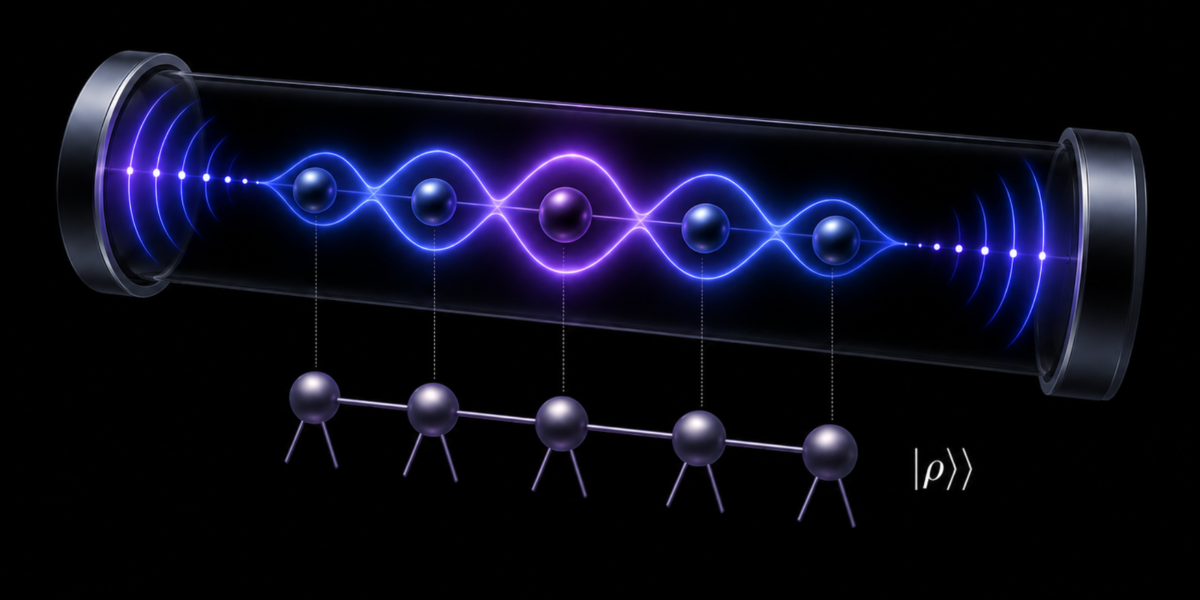
© Sebastian Paeckel · lmu.de Ludwig Maximilian University (LMU) physicists have devised a method to reveal previously hidden dynamics within complex quantum systems. The team, led by Sebastian Paeckel, extended time evolution into a technique building on the connection between imaginary time and thermal properties.
This innovation overcomes a fundamental barrier in simulating open quantum systems, where dynamical states were previously exponentially suppressed. “The results show how the new spectral information can be used not only to understand quantum dynamics, but also to control it,” says Paeckel, with the team’s findings published in Physical Review X.
Complex Time Extension Reveals Hidden Lindbladian Eigenmodes Previously inaccessible Lindbladian eigenmodes, which dictate the decay rate of collective excitations within a quantum system, are now observable thanks to a computational technique developed by researchers at Ludwig Maximilian University (LMU).
The team’s method circumvents an exponential suppression inherent in existing simulation approaches, allowing for the study of short-lived dynamical states important to understanding open quantum systems. This advancement stems from extending time evolution into a technique rooted in the established physics connecting imaginary time to thermal properties.
The new approach selectively amplifies contributions from specific dynamical modes during simulations. By manipulating the system’s dynamics within the simulation, researchers can exponentially enhance the visibility of these short-lived states before they decay, effectively creating a window into long-term physical behavior.
First author Philipp Westhoff, who completed this work as part of his master’s thesis and received a research award from the MCQST Cluster of Excellence, explained that “In this way, efficiently tractable simulations of short-time dynamics become a window into the physical behavior at long times.” The team’s findings, recently published in Physical Review X, demonstrate a pathway to systematically investigate complex open quantum systems.
Researchers applied this technique to a driven Bose-Hubbard model, a system describing interacting bosons, like ultracold atoms, subject to external, time-dependent forces. This model is relevant to experiments involving ultracold quantum gases, and the simulations revealed an unusual relaxation process where disturbances propagate differently than in standard diffusion.
The team observed the Mpemba effect, a counterintuitive phenomenon where a system can relax to its equilibrium state faster under certain conditions. Knowledge of the collective modes allows for deliberate selection of initial states, accelerating the system’s relaxation into a desired state, such as a Bose-Einstein condensate .
The ability to not only observe but also manipulate these dynamics represents a leap forward. Sebastian Paeckel. This control is achieved through the precise manipulation of the system’s initial state, using the understanding of collective modes gained through the complex time extension.
The team’s work provides a new framework for exploring the detailed interplay between quantum systems and their environments, potentially unlocking deeper insights into the behavior of complex quantum phenomena. The results show how the new spectral information can be used not only to understand quantum dynamics, but also to control it.
More like this Stay current See today’s quantum computing news on Quantum Zeitgeist for the latest breakthroughs in qubits, hardware, algorithms, and industry deals.
Article text via FreeNewsAPI. Rights remain with Quantum Zeitgeist.
Read on publisher site → Opens Quantum Zeitgeist in a new tab