Making the sustainable production of hydrogen peroxide more efficient
Hydrogen peroxide (H2O2) is a versatile chemical feedstock, whose industrial production relies predominantly on an energy-intensive process with a substantial environmental footprint. One alternat ...
hydrogen peroxide (H2O2) is a versatile chemical feedstock, whose industrial production relies predominantly on an energy-intensive process with a substantial environmental footprint. One alternative is to produce it using a catalyst activated by light. In an international research project involving the Max Planck Institute of Colloids and Interfaces, researchers have now developed a synthesis strategy that allows them to precisely control the spatial arrangement of ions in a carbon nitride .
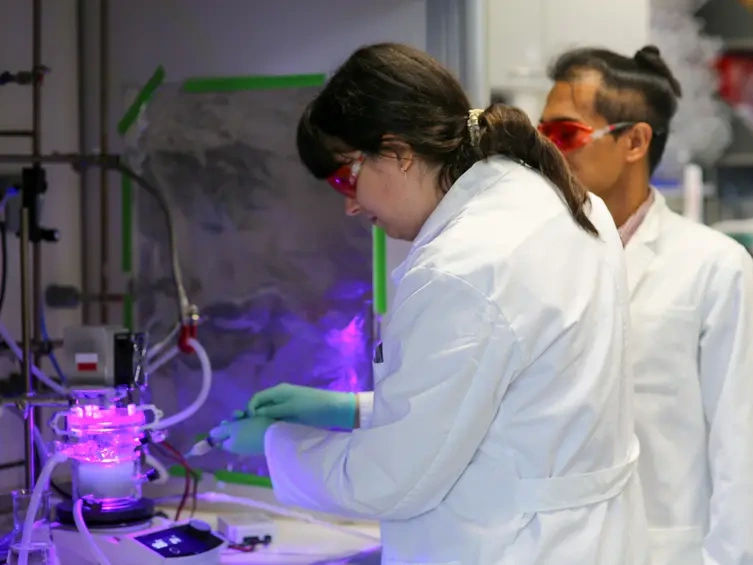
The resulting photocatalyst is three times as efficient as conventional green production methods. The findings have been published in the journal Advanced Materials. Anna Lo Presti and Christian Mark Pelicano are working on the photocatalyst in the laboratory. © MPIKG/Neubauer Hydrogen peroxide is an environmentally friendly oxidizing agent.
When it decomposes, it produces only water and oxygen, which is why it is also known as a “green chemical”. As demand grows, particularly for environmentally friendly wastewater treatment and household and medical disinfection, production volumes continue to rise. To meet this demand, hydrogen peroxide is still produced predominantly using the so-called anthraquinone process, which incurs high energy costs and has a substantial carbon footprint.
Photocatalysis is a promising alternative. In this process, a material absorbs light and uses its energy to drive a chemical reaction without fossil energy. The efficiency of the reaction depends, among other things, on how readily the charges generated by light can move through the material and how long they remain available to drive the reaction.
The research group therefore investigated how these properties could be influenced as early as the chemical assembly of the photocatalyst. “Instead of changing the chemical composition of a photocatalyst to make it more efficient, we tried to change how the building blocks are arranged,” says corresponding author Dr.
Christian M. Pelicano, who leads the “SunThesis” research group at the Max Planck Institute in Potsdam and has been researching this topic since 2023. To achieve this, the researchers used organic–inorganic ionic cocrystals.
These make it possible to predict precisely how the ions will be distributed as the crystals are thermally converted into the final material. Using this approach, the team developed a material called “CALiK”. It is a crystalline carbon nitride belonging to the polyheptazine imide (PHI) class of materials and contains lithium and potassium ions in a spatially controlled environment.
“These crystals were already known, but we were the first to use them as precursors for carbon nitrides. What caught our interest was that they contain the same chemical components as the precursors we normally use. The key difference is that the ions are already arranged in a specific way, and we wondered whether this arrangement could be transferred to the carbon nitride material”, says Pelicano.
In conventional production methods, these ions are usually introduced into the material in a disordered manner, using a molten salt. This offers only limited control over their spatial distribution. Comparative experiments with materials produced by other methods helped the team understand the influence of the chosen synthesis strategy, independently of the chemical composition alone.
A defined arrangement of ions improves photocatalytic performance Under the conditions tested, CALiK produced around three times as much hydrogen peroxide as the conventionally prepared comparison material KPHI and around 40 percent more than the best-performing material tested that contained only one type of cation, CALi.
When irradiated with light at a wavelength of 410 nanometers, CALiK achieved an apparent quantum yield of 58 percent, the highest among the catalysts compared. This measure describes how useful light photons are converted into electrons for entering the chemical reaction. “The spatial arrangement of the ions in the optimized material makes a considerable difference,” says first author Anna Lo Presti, a chemist pursuing her PhD on this topic at the Max Planck Institute.
“We were able to demonstrate for the first time that it is not only the type or quantity of ions that matters, but also their position in the lattice.” To investigate the reason for the improved performance, the researchers combined structural analyses with spectroscopic and electrochemical measurements.
They found that the charges generated by light separate more effectively in CALiK, and therefore remain available for the reaction with oxygen for longer. Additional calculations suggest that the spatial distribution of lithium ions changes the electronic environment within the material, thereby facilitating oxygen activation.
It should be noted, however, that the calculations are based on simplified model structures and therefore do not yet fully capture the processes in the real material. Nevertheless, the study provides an exciting and intuitive approach to optimize polymeric photocatalysts already during their synthesis.
Original publication Lo Presti, A., Hajiahmadi, Z., Hillman, S. A. J., Xiao, M., Durrant, J.
R., Kühne, T. D., et al. (2026). Ionic cocrystal programming of spatial ionic organization in carbon nitrides enables highly efficient H2O2 photosynthesis.
Advanced Materials, e75258.
Article text via FreeNewsAPI. Rights remain with chemeurope.com.
Read on publisher site → Opens chemeurope.com in a new tab