Researchers modeled a possible origin of little red dots — Space.com
Researchers at Johns Hopkins University in Maryland, United States, modeled scenarios in which the object Abell 2744-QSO1, from the class of so-called little red dots, may be associated with a primordial...
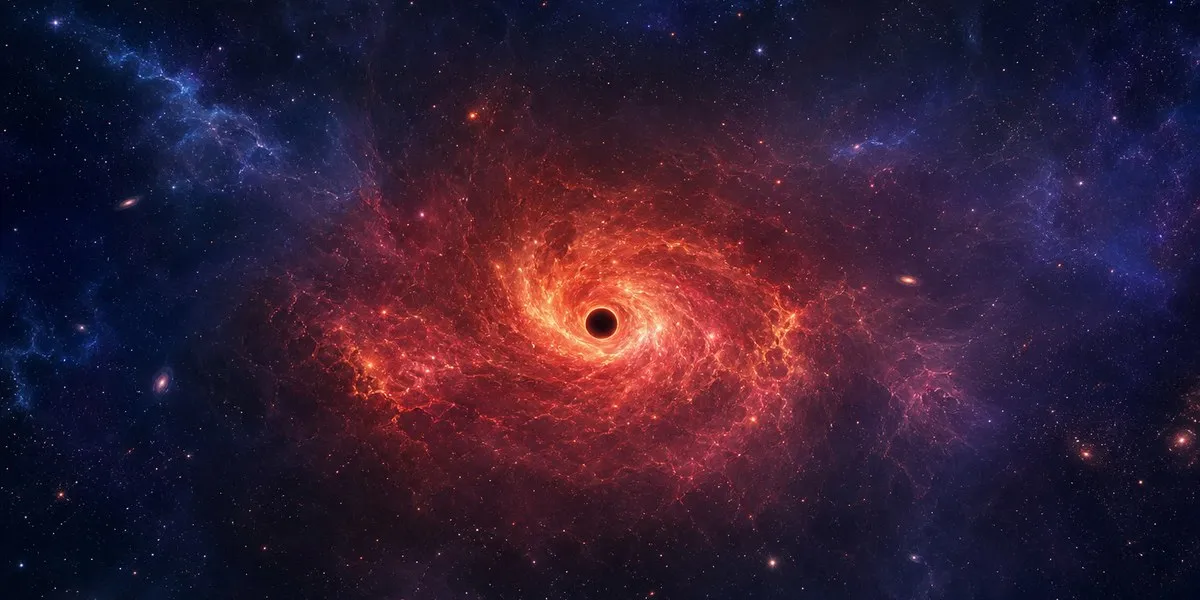
Researchers at Johns Hopkins University in Maryland, United States, modeled scenarios in which the object Abell 2744-QSO1, from the class of so-called little red dots, may be associated with a primordial black hole. Of the three options considered, they called the most likely the scenario in which a small primordial black hole absorbed surrounding gas and energy and grew to the size of QSO1.
Space.com reports this. Little red dots are cosmic objects that the James Webb telescope observes in the early Universe. According to available observations, they disappear completely before the Universe reaches two billion years of age.
The peculiarity of Abell 2744-QSO1 Abell 2744-QSO1 is located approximately 13.1 billion light-years from Earth. The telescope observes it as it was 700 million years after the Big Bang. The object consists almost entirely of hydrogen and helium, the first chemical elements in the Universe.
According to the authors of the study, this may mean that it has retained more primordial properties than other little red dots. More current news is available on the UA.News Telegram channel Telegram . Primordial black holes, if they exist, could have formed due to fluctuations in matter density in the earliest moments after the Big Bang, rather than as a result of the deaths of massive stars.
They would then have emerged before stars, cosmic dust, and chemical elements heavier than hydrogen and helium. Further checks Research team member Valerio De Luca noted that little red dots may also surround ordinary astrophysical black holes that form after the collapse of massive stars.
Therefore, scientists need to distinguish possible primordial black holes from astrophysical ones. Cosmological observations also limit the possible number of such objects in the Universe and in individual clusters. The researchers plan to analyze about 100 more little red dots recorded by the James Webb telescope.
The results of the study were published in June in the journal Physical Review Letters.
Article text via FreeNewsAPI. Rights remain with UA.NEWS.
Read on publisher site → Opens UA.NEWS in a new tab