Space Crops and Advanced Tech Wrap Up Week Following Spacewalk
Space crops research wrapped up the week following the completion of the first of two power upgrade spacewalks at the International Space Station. The Expedition 75 crew members rounded out their research schedule with virtual reality and super intelligence studies.
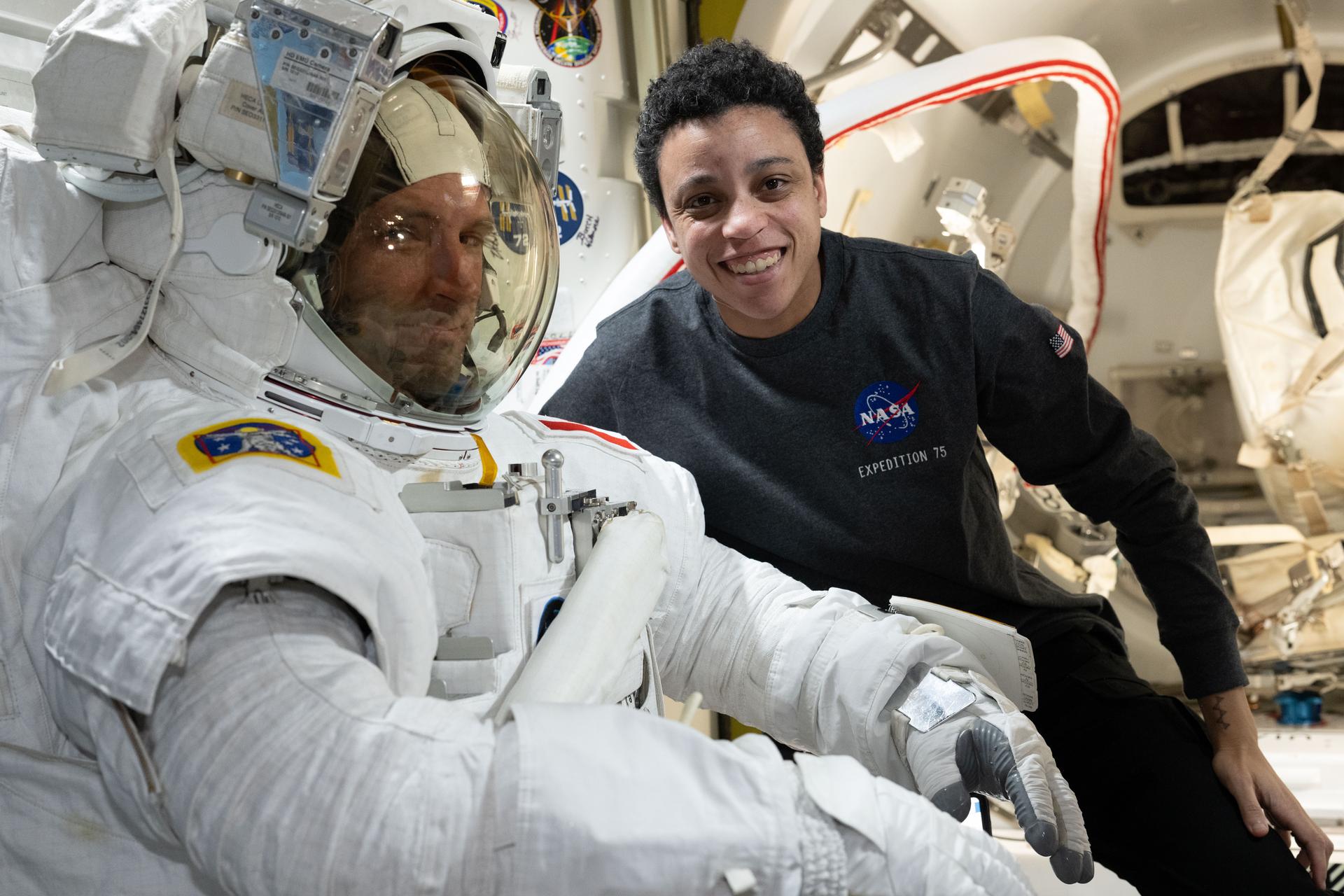
Space crops research wrapped up the week following the completion of the first of two power upgrade spacewalks at the International Space Station . The Expedition 75 crew members rounded out their research schedule with virtual reality and super intelligence studies. The orbital outpost has a new roll-out solar array that is generating power after flight engineers Anil Menon of NASA and Joshua Kutryk of CSA (Canadian Space Agency) installed it during a spacewalk on Thursday .
Menon and Kutryk spent seven hours and 11 minutes in the vacuum of space attaching the roll-out solar array to the port side truss structure then releasing its tension bolts allowing the solar array to unfurl, or roll out, on its own during a ten-minute process. The pair will install one more roll-out solar array on Thursday, Nov.
5, to complete the yearslong process that began in June 2021 to augment the space station’s power generation system. Menon and Kutryk will install the eighth and final roll-out solar array on the starboard side of the truss structure increasing the station’s power generating capacity from 160 kilowatts to about 215 kilowatts.
Menon and Kutryk had a light duty day on Friday with ongoing research planned for their short schedule. Menon worked on a space botany investigation in the Kibo laboratory module exploring how microgravity affects cell division on green algae and cultured tobacco cells. Results may support the production of food crops on the Moon and Mars.
Kutryk pedaled on the European Enhanced Exploration Exercise Device’s (E4D) exercise cycle in the Columbus laboratory module . The compact all-in-one E4D is being tested for its ability to keep crews fit during a long-term spaceflight. NASA flight engineer Luke Delaney also studied space-based crops focusing on how to prevent plant diseases in microgravity.
Delaney inoculated thale cress plant samples after they were exposed to a fungal pathogen then stowed the samples inside an artificial gravity-generating incubator . Results may improve crop disease resistance both on Earth and in space. NASA flight engineer Jessica Watkins spent her shift servicing a variety of research hardware.
She first removed and photographed components inside a device that powers experiments launched aboard spacecraft. Next, Watkins swapped moisture absorbers inside a set of portable science freezers that can be launched to the station and returned back to Earth housing frozen research samples for analysis.
Station commander Pyotr Dubrov of Roscosmos worked on a physics experiment swapping hardware inside a temperature-controlled chamber to explore manufacturing high-purity semiconductor crystals in microgravity. Flight engineer Sergey Teteryatnikov wore a virtual reality headset and responded to computerized visual stimuli to testing how his sense of balance and orientation is adapting to microgravity.
Flight engineer Anna Kikina studied how super intelligence tools may increase operational and communications efficiency aboard a spacecraft. Learn more about station activities by following the space station blog , @space_station on X, as well as the ISS Facebook and ISS Instagram accounts.
Get the latest from NASA delivered every week. Subscribe here .
Article text via FreeNewsAPI. Rights remain with NASA (.gov).
Read on publisher site → Opens NASA (.gov) in a new tab