Squeezing magnetic crystals offers new insight into electron behavior
A small mechanical squeeze changed magnetic behavior and electrical signals in manganese telluride and iron sulfide crystals.Neutron measurements revealed how strain redistributed magnetic domains, with...
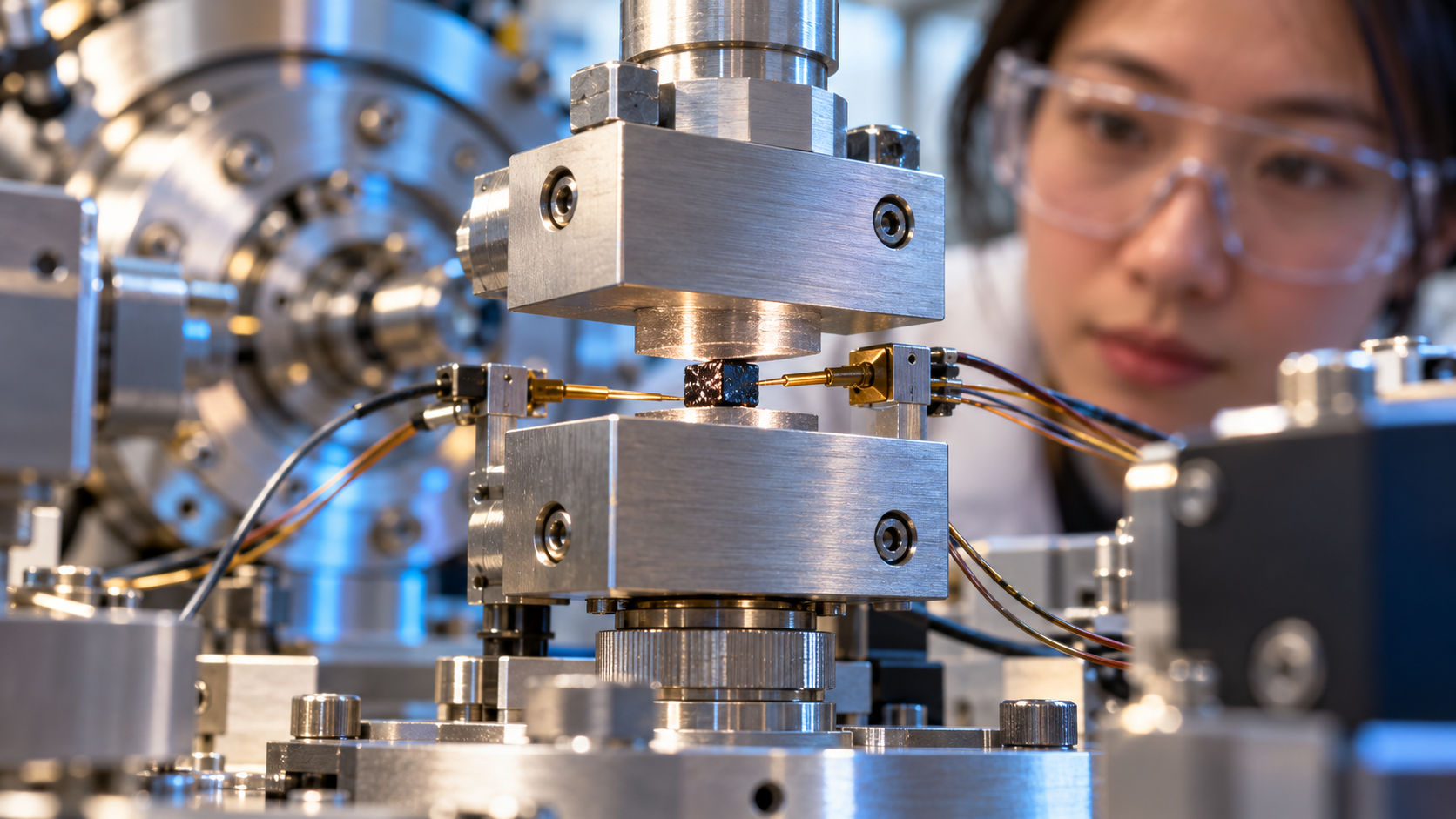
A small mechanical squeeze changed magnetic behavior and electrical signals in manganese telluride and iron sulfide crystals. Neutron measurements revealed how strain redistributed magnetic domains, with different responses in the two materials. The results suggest a possible control method for future spintronics, but they do not demonstrate a finished electronic device.
A tiny squeeze can change how a magnetic crystal responds to an electrical current. In two materials being investigated for spin-based electronics, researchers found that mechanical strain reshaped magnetic arrangements and altered a measurable electrical signal. The experiments offer a way to investigate magnetism that can remain largely hidden in an untouched crystal.
Scientists used neutron instruments at the Department of Energy’s Oak Ridge National Laboratory , or ORNL, to examine manganese telluride and iron sulfide. Their findings appear in a manganese telluride study in Physical Review X and an iron sulfide study in Advanced Materials . Both investigate materials associated with an emerging magnetic category called altermagnetism, although the iron sulfide paper describes its material as an altermagnet candidate.
The appeal lies in controlling magnetic behavior without relying on a large overall magnetization. Such control could help researchers develop spintronics, which uses electron spin alongside electrical charge to handle information. For now, the experiments establish material behavior, rather than a working memory chip or computing system.
Before and after neutron diffraction patterns show how mechanical strain changes magnetic domain populations in altermagnetic materials, demonstrating a potential way to control magnetism for future spintronic technologies. (CREDIT Phoenix Pleasant/ORNL, U.S. Dept. of Energy) Why altermagnets attract attention An electron’s spin is a quantum property associated with its magnetism.
In a conventional ferromagnet, magnetic moments can align to produce an overall magnetization. Antiferromagnets instead have opposing moments that cancel, making their magnetic order harder to detect and manipulate through ordinary magnetic measurements. Altermagnets combine compensated magnetic order with electronic properties that depend on spin and the direction of electron momentum.
Their crystal symmetry distinguishes them from conventional antiferromagnets. That combination has made them attractive candidates for investigating spin-based information storage without the substantial net magnetization associated with familiar permanent magnets. Yet an individual crystal need not adopt one uniform magnetic arrangement throughout.
Different regions, called magnetic domains, can have equivalent orientations pointing in different directions. Measurements combine their contributions, potentially obscuring the underlying structure and complicating efforts to connect magnetism with electrical behavior. A squeeze makes magnetic domains easier to read The experimental idea was straightforward: compress tiny crystals between titanium plates and examine the response.
Strain means the resulting deformation of the material, rather than simply the force applied to it. Altering the crystal’s geometry can change which magnetic orientations are energetically favored. The crystal structure of h-FeS reveals how iron atoms interact with surrounding sulfur atoms, while diagrams show the arrangement of electron spins and changes in orbital states under different crystal fields. (CREDIT: Pengcheng Dai et al, Advanced Materials 2026) In manganese telluride, compression along selected crystal directions produced a single in-plane magnetic domain.
That allowed the team to determine the underlying moment orientation more clearly. Separate measurements using a piezoelectric strain cell also showed that strain could reverse the sign of its anomalous Hall response near room temperature, without changing the magnetic transition temperature.
“By controlling the magnetic domains, we can directly influence the transport behavior, and that opens the door to exploring these materials for spintronic technologies,” said Pengcheng Dai, a professor of physics and astronomy at Rice University . Dai previously worked as a neutron scientist at ORNL.
The work connects domain control with electrical measurements, helping researchers separate magnetic configurations that otherwise coexist inside a sample. What neutrons reveal inside a crystal Electrical measurements alone cannot establish exactly how spins have rearranged. Neutron scattering supplies complementary evidence because neutrons interact with magnetic moments inside a material.
The resulting diffraction patterns allow researchers to test proposed magnetic structures against measurements, rather than infer them solely from an electrical signal. The experiments used ORNL’s Spallation Neutron Source, a DOE Office of Science user facility. Feng Ye, an ORNL neutron scientist and co-author of both papers, emphasized the value of this combination.
A simple mechanical squeeze could reveal unfamiliar behavior, he explained, while neutron scattering identified the underlying magnetic changes. Together, the methods let researchers connect a macroscopic electrical measurement with arrangements inside the crystal that cannot be established from that measurement alone.
In the iron sulfide experiments, the positions of the measured diffraction peaks remained unchanged under compression. Their intensities, however, shifted substantially. That pattern indicated a redistribution of magnetic domains while the dominant magnetic structure remained intact, rather than a wholesale replacement of the material’s magnetic order.
Magnetization measurements reveal how compressive strain affects the magnetic behavior of h-FeS at different temperatures, including changes above and below its magnetic transition. (CREDIT: Pengcheng Dai et al, Advanced Materials 2026) Before compression, three in-plane domain orientations occupied roughly equal shares of the sample.
Under strain, one orientation fell to an estimated 2%, while the other two each reached about 49%. Those measurements showed that a modest deformation could strongly favor some orientations over another, even though it did not produce a single-domain state in this material. Iron sulfide responds differently The iron sulfide crystals had a composition close to Fe0.93S, reflecting a slight shortage of iron .
Their magnetic behavior also changed with temperature. For one sample, a transition around 156 kelvins, approximately minus 179 degrees Fahrenheit, separated a higher-temperature configuration with moments mainly within the crystal plane from a lower-temperature arrangement along its vertical axis.
Above that transition, the moments tilted slightly out of the plane, a feature called spin canting. This produced a tiny net magnetic contribution alongside the much larger, opposing magnetic order. Compression reduced that contribution and also suppressed the spontaneous anomalous Hall effect, an electrical response involving a voltage transverse to the current.
The strain used for the magnetization measurements was about 0.25%, a small fractional deformation. Its effect illustrates how sensitive magnetic materials can be to their local atomic surroundings. However, the two experiments did not show identical behavior: manganese telluride reached a single-domain state, while iron sulfide retained two dominant domains.
Domain changes do not explain everything An important qualification appears in the iron sulfide analysis. The researchers do not expect the observed domain redistribution, by itself, to change the strength of its spontaneous Hall response. The coinciding changes therefore require a more detailed explanation than simply removing one domain orientation from the mixture.
Neutron diffraction images reveal how compressive strain and temperature affect the crystal structure of h-FeS, highlighting changes in diffraction peaks at 300 K and 120 K. (CREDIT: Pengcheng Dai et al, Advanced Materials 2026) Their interpretation involves how strain alters the local surroundings of iron ions.
This could weaken the influence of spin-orbit coupling, the interaction linking electron spin with orbital motion. Reduced canting and a smaller Hall response could then follow from the same underlying change, although the microscopic explanation still requires further theoretical investigation.
Additional neutron measurements examined spin waves, collective disturbances of the magnetic moments. Above the transition, the measured energy gap was smaller than the instrument could resolve, below 0.5 millielectronvolts. This small barrier helps explain why relatively limited stress could redistribute domains, linking their flexibility to the material’s magnetic excitations .
From material control to future devices The studies suggest mechanical strain deserves attention as a control method for altermagnetic materials. They do not establish a universal response across the entire class. Composition, temperature, crystal direction and the details of magnetic interactions all matter when interpreting the electrical changes.
Future spintronic devices would need controlled magnetic states that can be read and manipulated reliably. These results address part of that challenge by connecting applied strain, magnetic measurements and electrical response. They leave the practical engineering of an integrated component outside the demonstrated findings.
For iron sulfide, one unresolved question is how precisely its tiny net magnetic moment relates to its unusually strong Hall response. The authors propose testing whether similar linked changes occur in other compensated magnets. Those comparisons could establish which strain responses are specific to individual crystals and which offer a broader route to controlling spin-dependent electronics.
Dig deeper into altermagnetism and magnetic control These resources trace the field from its symmetry foundations to experimental imaging and possible electronic applications. Altermagnets as a new class of functional materials This perspective examines experimental progress and potential uses in spintronics, magnetic excitations and other emerging technologies. (Nature Reviews Materials, February 2025) Altermagnetic lifting of Kramers spin degeneracy Photoemission measurements and calculations identified distinctive spin-dependent electronic behavior in manganese telluride. (Nature, February 2024) Research findings are available online in the journal Advanced Materials .
Scientists reshape light to control magnetic memory and a material's magnetic properties New material stores four magnetic states per cell - exponentially increasing memory storage Ultra-thin new material shields spacecraft from electromagnetic waves and radiation
Article text via FreeNewsAPI. Rights remain with The Brighter Side of News.
Read on publisher site → Opens The Brighter Side of News in a new tab