This ancient meteorite is a rare time capsule from early Mars
When a rose-colored meteorite was discovered in the Sahara Desert in 2022, it looked unusual. But nobody knew just how extraordinary it was. Now, after detailed laboratory analysis, scientists have revealed...
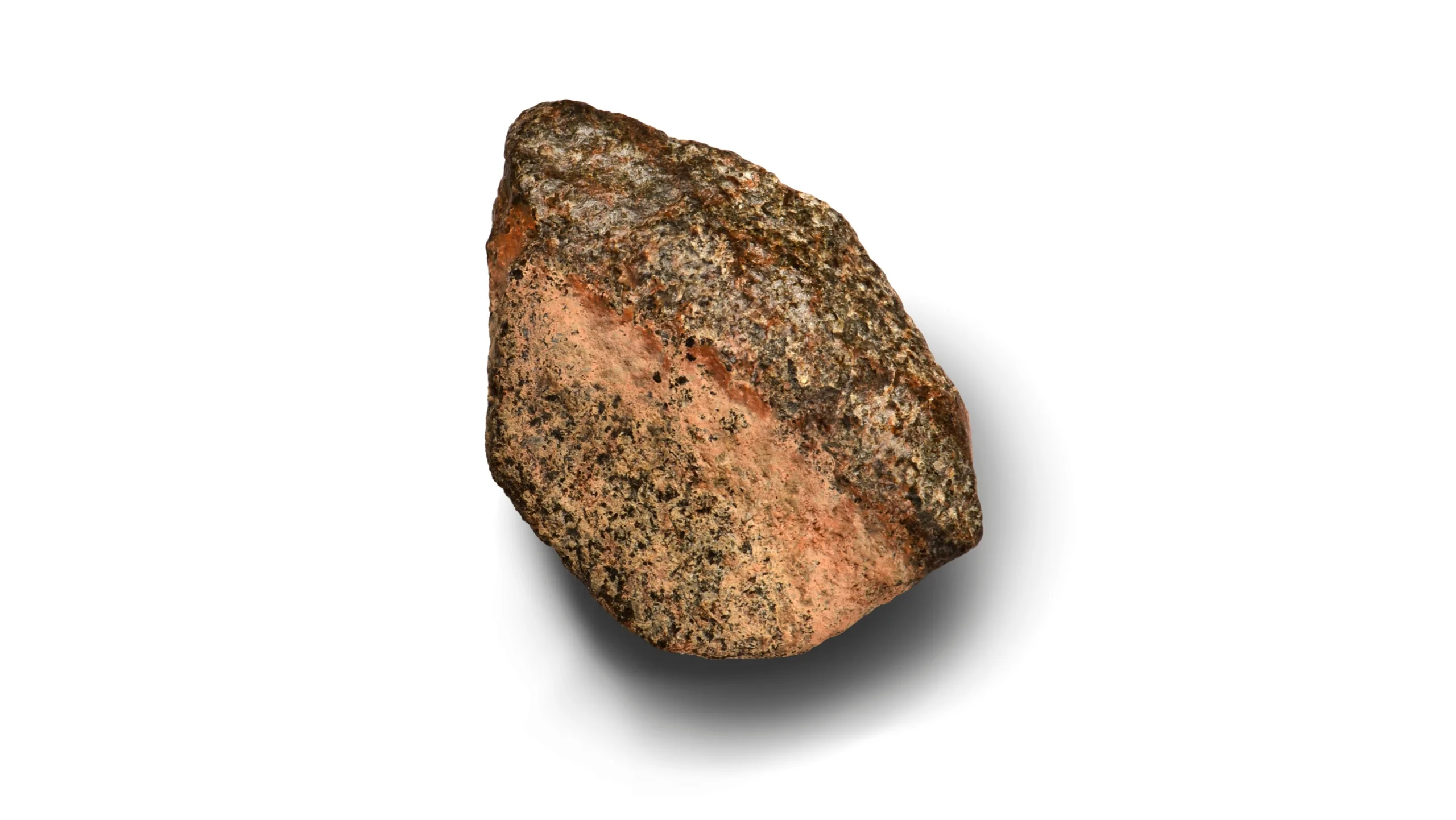
When a rose-colored meteorite was discovered in the Sahara Desert in 2022, it looked unusual. But nobody knew just how extraordinary it was. Now, after detailed laboratory analysis, scientists have revealed that the rock, named Teghaza 001, is one of the oldest known pieces of Mars ever found on Earth.
At more than 4.1 billion years old, the meteorite offers a remarkably well-preserved record of the Red Planet during a period when water flowed across its surface, and its crust was still taking shape. The findings, published in Science, are giving researchers an unprecedented look at a chapter of Martian history that has largely remained out of reach.
“It was only after we started looking closely that we realized this meteorite is really unique, ” said lead author Yang Liu of NASA’s Jet Propulsion Laboratory. “One of the paper’s reviewers called it a Rosetta Stone for Mars.” Scientists have identified only about 435 Martian meteorites on Earth.
All were blasted off Mars by powerful impacts before eventually finding their way to our planet. Teghaza 001 stands out even among that exclusive group. The meteorite weighs nearly two pounds (800 grams) and contains an unusual mixture of volcanic minerals.
Unlike most Martian meteorites, which often provide only limited snapshots of the planet’s history , Teghaza 001 appears to preserve evidence of multiple stages of Mars’ early evolution . Its mineral composition indicates that it formed from cooling magma deep within the ancient Martian crust before later being altered by interactions with liquid water.
That combination makes it especially valuable. Researchers believe the meteorite may originate from the heavily cratered southern highlands of Mars, one of the oldest regions on the planet. This slice of Teghaza 001, a Martian meteorite, was used to study its mineralogy and chemistry.
Credit: NASA/JPL-Caltech Its mineralogy closely resembles materials observed from orbit by NASA’s Mars Reconnaissance Orbiter. “This is really our first piece of Martian crust from a part of Mars we’ve never had a sample of before,” said co-author Lee Saper, now a scientist at NASA’s Ames Research Center.
“It records interactions of water and rock and maybe even an imprint of the Martian atmosphere as it was losing water.” Although scientists cannot pinpoint exactly where on Mars the rock came from , identifying potential source regions helps connect laboratory studies with observations made by orbiters and rovers exploring the planet today.
One of the study’s most intriguing findings involves water. Mars today is cold, dry, and largely inhospitable. But evidence continues to accumulate that billions of years ago it was a very different world, with rivers, lakes, and possibly even oceans.
Teghaza 001 appears to preserve signs of that wetter era. Researchers have found zircon crystals in the meteorite that served as miniature geological time-keeping devices. Scientists were able to use these crystals to figure out both when the meteorite was created and when the crystal itself was chemically altered due to contact with water.
The results suggest that water interacted with the rock around 4.1 billion years ago, meaning the crust itself likely formed even earlier. The findings add to growing evidence that ancient Mars hosted an active water cycle far earlier in its history than many scientists once suspected.
Part of what made the discovery possible was a powerful new method for age-dating ancient rocks. Rather than dissolving a sample and analyzing it in bulk, researchers used a highly precise technique that examines individual mineral grains directly. Co-author Francois Tissot of Caltech helped apply the method, which uses rubidium and strontium isotopes to determine ages while preserving rare planetary samples.
“Right now, we are one of very few labs in the world able to perform this kind of age-dating, and the first to date such an ancient Martian meteorite,” Tissot said. “Our hope is to pave the way for dating even more Martian meteorites, or samples returned from other planets, their moons, and asteroids.” The approach allowed the team to study a fragment smaller than a fingernail while leaving most of the meteorite intact for future investigations.
Scientists emphasize that Teghaza 001 has likely revealed only a fraction of its secrets. The rock contains a wealth of information about early Martian geology , water activity, and possibly even atmospheric evolution. Researchers expect many more studies to follow as laboratories around the world analyze the sample in greater detail.
The first parts of Mars’ geologic past are primarily unknown to us. Thus, every early meteorite we find has great value. Teghaza 001 is of particular interest as well, since it appears to represent a time when Mars transitioned from being a young volcanic planet to a world influenced by interactions between rock and water.
“We’ve only scratched the surface,” Liu said. For scientists trying to reconstruct the story of ancient Mars, this rose-colored rock may become one of the most important clues ever found. Journal Reference: Yang Liu, Lee Saper, Elizabeth Ann Bell, Chi Ma et al.
A Martian meteorite that formed ≳4.1 billion years ago samples Mars’ early crust and mantle. Science. DOI: 10.1126/science.adz5646
Article text via FreeNewsAPI. Rights remain with Tech Explorist.
Read on publisher site → Opens Tech Explorist in a new tab