Webb Finds Dust-Rich Water Ice in Interstellar Comet 3I/ATLAS
Astronomers using the NASA/ESA/CSA James Webb Space Telescope have found that the water ice in the interstellar comet 3I/ATLAS is mixed with dark, rocky material in tiny grains. The grains’ spectral...
Astronomers using the NASA/ESA/CSA James Webb Space Telescope have found that the water ice in the interstellar comet 3I/ATLAS is mixed with dark, rocky material in tiny grains. The grains’ spectral characteristics differ from those of ice grains in solar system comets but resemble the spectra of some icy worlds beyond Neptune.
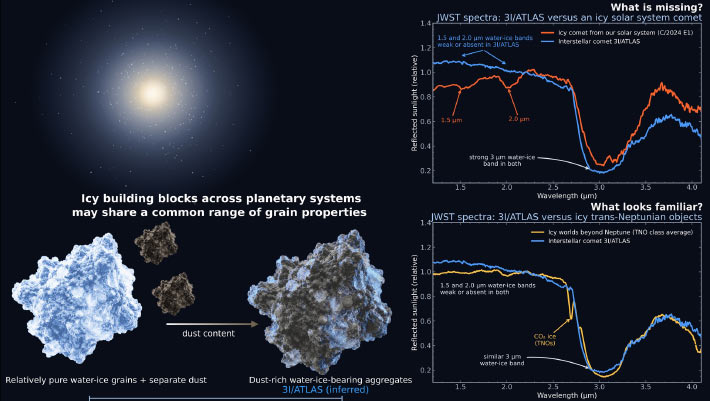
Protopapa et al . used Webb to compare the interstellar comet 3I/ATLAS with icy bodies in our Solar System; the comparison offers clues to the early formation of planetary building blocks; at top right, both 3I/ATLAS and the icy solar system comet C/2024 E1 show a strong water-ice absorption band near 3 microns, but the interstellar comet has very weak or missing bands near 1.5 and 2.0 microns; its spectrum more closely resembles the average spectrum of a class of icy worlds beyond Neptune whose spectra also show carbon dioxide ice and organics (bottom right); the artist’s concept (left, not to scale) compares the relatively pure ice grains with separate dust, as interpreted for most solar system comets, with the dust-rich ice aggregates the study inferred for 3I/ATLAS.
Image credit: SwRI / Silvia Protopapa / NASA / ESA / CSA / JWST. “Interstellar comets are small icy bodies that formed in the disks of gas and dust around other stars and are now passing through our Solar System,” said Dr. Silvia Protopapa, an astronomer at the Southwest Research Institute.
“As 3I/ATLAS warms up, gas escaping from its interior carries ice and dust grains into the surrounding cloud, or coma.” “Those grains hold clues to the conditions where the comet was born.” Dr. Protopapa and colleagues observed 3I/ATLAS with Webb’s NIRSpec instrument on three dates: August 6, 2025, December 22, 2025, and April 1, 2026.
These spanned about eight months around the comet’s closest approach to the Sun on October 29, 2025. The spectra show a strong water-ice absorption plus gas emission from water, carbon dioxide and carbon monoxide. But the weaker water-ice signatures, which are usually seen in icy comets, were faint or missing.
According to the team’s modeling, the best explanation is grains smaller than a few micrometers, each a blend of water ice and refractory material. “The grains of 3I/ATLAS are about the same size as those in our own comets,”Dr. Protopapa said.
“What seems to set them apart is how much dust is mixed into the ice.” The April 2026 spectrum also hints at a second population of larger, micron-sized ice-rich grains. “We can’t yet tell whether the changes over time are the result of the Sun heating the grains differently at each observation, or of new material exposed as the comet’s surface eroded near the Sun,” said Dr.
Michael Kelley, an astronomer at the University of Maryland. “Both are possible, and telling them apart is one of the open questions we aim to address.” The reserchers also compared 3I/ATLAS with other comets and with several classes of trans-Neptunian objects. They suggest icy planetesimals formed around different stars may share a continuum of ice grain properties, from pure ice to ice mixed with refractory material, with 3I/ATLAS toward the refractory-rich end.
“At first glance, 3I/ATLAS looks different from the icy comets we know,” Dr. Protopapa said. “But when we placed it alongside distant icy worlds in our own Solar System, it no longer looked out of place.” “This suggests that the icy building blocks of planets, here and around other stars, may share ice in the form of tiny, micron-scale grains, ranging from relatively pure ice to ice mixed with dust, with 3I/ATLAS toward the dusty end.” “If confirmed, this shared range of grain properties could indicate that the physical form of water ice is established early, in planet-forming disks, and is at least partly preserved in the icy bodies that form there.” The results appear in the Astrophysical Journal Letters . _____ Silvia Protopapa et al .
2026. JWST Reveals Refractory-rich Water Ice in Interstellar Comet 3I/ATLAS: Evidence for a Continuum of Grain Properties across Protoplanetary Disks. ApJL 1011, L11; doi: 10.3847/2041-8213/aea60d
Article text via FreeNewsAPI. Rights remain with Sci.News.
Read on publisher site → Opens Sci.News in a new tab