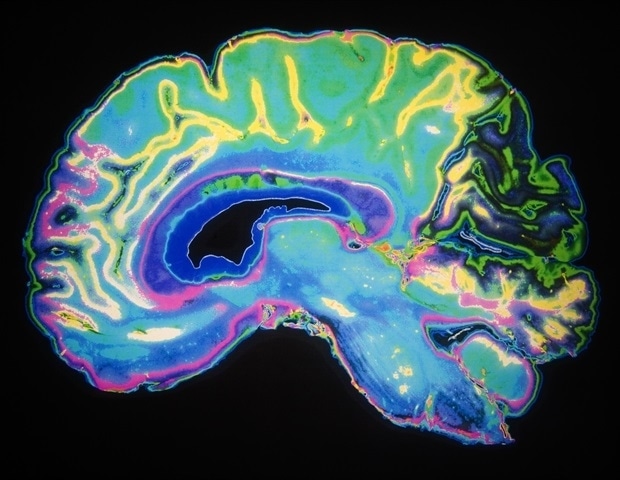
Why Right Side of Your Brain Runs Left Side of Your Body
In a new hypothesis paper, two neuroscientists at the University of Minnesota argue that the crossed arrangement of the mammalian cortex was probably not an adaptation that gave animals a survival edge; it was, they propose, a matter of history.
It is one of the first facts students learn about the brain, and one of the strangest: the right hemisphere controls the left side of the body, and the left hemisphere controls the right. Scientists have proposed explanations for centuries. In a new hypothesis paper, two neuroscientists at the University of Minnesota argue that the crossed arrangement of the mammalian cortex was probably not an adaptation that gave animals a survival edge; it was, they propose, a matter of history.
Martin W. Wessendorf & Daniel Delie Wang trace the crossed wiring of vertebrate brains to the evolution of vision, and say the mammalian cortex simply inherited the arrangement. “In humans, the right motor cortex controls the spinal motoneurons that cause the limbs on the left sides of our bodies to move,” University of Minnesota researchers Martin Wessendorf and Daniel Delie Wang said in their paper.
“Similarly, the right side of the cerebral cortex predominantly receives sensory information about the left side of our bodies and the left side of the outside world.” “Although there have been numerous papers — dating back at least to the anatomist Santiago Ramón y Cajal — speculating on the adaptive value of this contralateral organization, to date none appears to have examined its evolutionary history.” The authors surveyed decades of comparative studies of brain circuits across fish, amphibians, reptiles, birds and mammals, and looked for patterns in which animals share which traits.
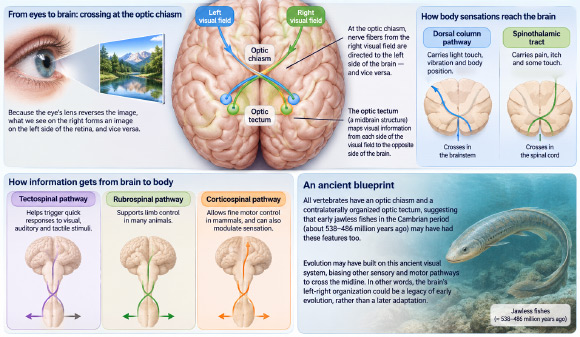
Their central finding is that vision is the most ancient crossed system. Every vertebrate species reported, from lampreys and hagfish to humans, has an optic chiasm, the structure where visual fibers cross. Input from each visual field is carried to the opposite optic tectum, a midbrain region called the superior colliculus in mammals.
Dr. Wessendorf and Dr. Wang conclude that the last common ancestor of vertebrates likely had both.
Other crossed circuits appear to have arrived later. According to the paper, the touch and pain pathways to the thalamus, the tectospinal tract and the rubrospinal tract (motor pathways running from the midbrain to the spinal cord) were likely present in the last common ancestor of tetrapods, the four-limbed vertebrates.
The corticospinal tract, the main route from the cortex to the spinal cord, is unique to mammals, though the authors note a similar projection reported in some birds. The researchers propose that the crossed visual map in the optic tectum served as a template. Because the tectum also receives touch and hearing inputs and sends out motor commands, other sensory and motor systems aligned with it.
By the time mammals appeared, roughly 165 million years ago, many major pathways were already crossed. An uncrossed neocortex would not have been impossible, but it would have required either adding several extra crossings or rewiring existing circuits. This would likely have raised ‘wiring costs,’ meaning slower function, higher energy demands, or both.
The ‘most economical way’ for the neocortex to connect with existing circuits was to be crossed as well. The scientists also note that the corticospinal tract varies across species. It is bilateral in goats and elephants and mostly uncrossed in hedgehogs and moles, which they take as a sign that its crossing is not strongly favored by natural selection.
The authors review six earlier hypotheses, including that crossing strengthens the nervous system structurally, helps animals survive injury, solves an engineering problem in steering toward goals, or reflects an ancient twist in the body plan. They find each has weaknesses: for example, a topological argument that crossings are needed to preserve spatial maps would imply that every mapped pathway must cross, which is not the case.
They stress that their idea is a hypothesis, and they list testable predictions. These include whether Cambrian fossils of early vertebrates preserve an optic tectum and chiasm, whether crocodilians and a wide range of birds have crossed telencephalic tracts to the spinal cord, and whether crossed wiring proves more efficient than plausible uncrossed alternatives.
“We propose that evolutionarily ancient visual pathways biased our central nervous systems towards being organized contralaterally — at least in tetrapods,” they said. “Given that all living vertebrates have both an optic chiasm and a contralaterally organized optic tectum, we think that Cambrian-era jawless fishes that lived roughly 538 to 486 million years ago had both an optic chiasm and an optic tectum.” “It may be possible to test this hypothesis by examining fossilized remains of their skulls.” “Since evolution is conservative in its innovations — it often retains and builds upon existing structures, pathways, and mechanisms rather than inventing new ones — the organization of the visual system (and in particular, the optic tectum) may have defined the organizational principles required of the sensory and motor pathways that evolved later,” they added.
“We propose that contralateral organization didn’t necessarily evolve as an adaptation, but because evolution is an engineer that builds with the foundation and materials it has at hand.” Their paper was published in the journal Frontiers in Neuroanatomy . _____ Martin W. Wessendorf & Daniel Delie Wang.
2026. Why is the right side of the brain responsible for the left side of the body? The evolutionary history of a puzzling trait.
Front. Neuroanat 20; doi: 10.3389/fnana.2026.1937941
Article text via FreeNewsAPI. Rights remain with Sci.News.
Read on publisher site → Opens Sci.News in a new tab