Circular Dichroism Yields Value for Berry Curvature
Nele Tornow (pictured) and other researchers in Germany have carried out a new kind of experiment to measure the Berry curvature, in which they record the difference in intensity of second harmonics generated...
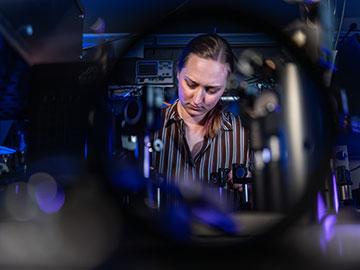
Nele Tornow (pictured) and other researchers in Germany have carried out a new kind of experiment to measure the Berry curvature, in which they record the difference in intensity of second harmonics generated by left- and right-circularly polarized light emerging from a semiconductor. [Image: Nele Tornow ] Scientists in Germany have shown how to measure the value of a quantum-mechanical parameter known as the Berry curvature using a relatively straightforward all-optical system exploiting nonlinear circular dichroism (Nat.
Photon., doi: 10.1038/s41566-026-02025-8 ). The researchers interpreted their experimental results using a newly developed theoretical model, and they reckon that their work could aid the development of new optical “valleytronic” devices. Toward experimental measurements Electrons in a crystal accelerated by an electric field speed up along the line of the field.
They can also attain a transverse velocity if exposed to a magnetic field, thanks to the Lorentz force. However, even in the absence of a magnetic field they can still acquire a velocity in the transverse direction given a finite value of the Berry curvature, which is technically defined as a magnetic field in reciprocal space.
This sets the electron in a circular motion. The Berry curvature can be fairly easily calculated using quantum theory but is much harder to measure experimentally. The main sticking point is the need to derive a suitable analytical expression from theory that specifies the values of experimental parameters needed to obtain the Berry curvature within an all-optical system—that can be built without great expense.
Obtaining the Berry curvature In the latest work, Giancarlo Soavi and Nele Tornow at the University of Jena, working with Jan Wilhelm at the University of Regensburg and colleagues from the two universities, have derived such an expression for experiments that exploit nonlinear circular dichroism.
This phenomenon involves a difference in intensity of second harmonics between left- and right-circularly polarized light. The scientists also observed a signal indicating that photons from the pump and probe beams were mixing to generate photons with their combined frequencies. The researchers’ scheme involves directing two laser beams—a pump and a probe—at a very thin layer of semiconductor.
The idea is to vary the time between the two beams and measure the intensities of second harmonics generated by the two types of polarized light emerging on the far side of the semiconductor layer. The difference between the intensities of the two different polarizations yields a value for the Berry curvature.
Implementing the scheme Soavi and colleagues implemented the scheme using fleeting pump and probe pulses at different wavelengths, which they directed at a layer of tungsten diselenide less than one nanometer thick. They recorded the layer’s optical response both with a delay longer than the pulse duration and with no delay at all, using suitable filters and wave plates to measure the left- and right-handed polarization components on the far side of the semiconductor.
At long delays, the researchers recorded only small second harmonics of the pump and probe beams within the subtracted intensity spectrum. When sending in the two pulses simultaneously, they instead recorded a more significant second harmonic from the probe pulse, which they say implies a finite amount of circular dichroism.
The scientists also observed a signal indicating that photons from the pump and probe beams were mixing to generate photons with their combined frequencies. The researchers used these data to work out the Berry curvature, calculating it to be 6.2 ± 1.4 Å 2 . They say this agrees well with reported values from two independent theoretical models based on tight binding and density functional theory.
They also report that the circular dichroism comes and goes extremely quickly—lasting for only around 300 femtoseconds (3 × 10 -13 s) a pop. Soavi and colleagues argue that their research provides scientists with a straightforward way of probing the Berry curvature, which is also known as the local quantum geometry.
They also believe it could potentially have technological applications by paving the way to ultrafast all-optical devices that encode data in three degrees of freedom: spin, valley (the extremes of a semiconductor’s electronic band structure) and Berry curvature. They note that their scheme should be applicable to other kinds of semiconductor besides tungsten diselenide.
Article text via FreeNewsAPI. Rights remain with Optics & Photonics News.
Read on publisher site → Opens Optics & Photonics News in a new tab