Eaton Wildfire Exposed Millions to a “Cocktail of Chemicals”
The January 2025 Eaton Fire in Los Angeles killed 19 people, forced the evacuation of more than 100,000 others, and destroyed upward of 9,000 structures. New research published today in Science Advances also...
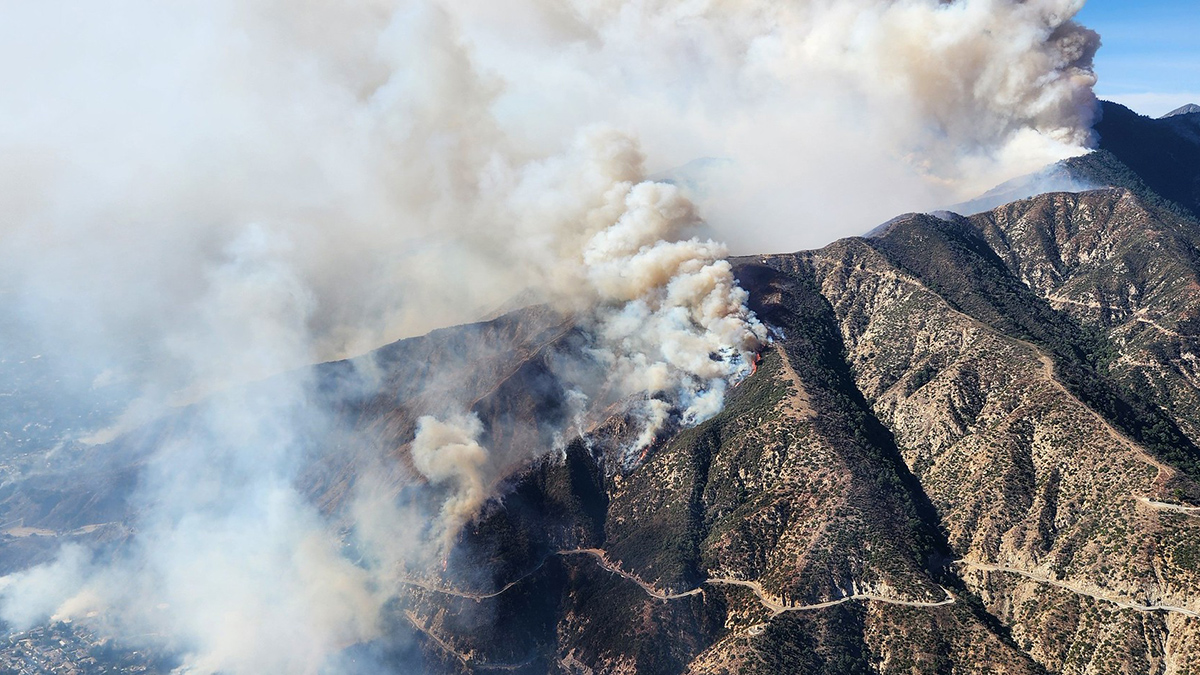
The January 2025 Eaton Fire in Los Angeles killed 19 people, forced the evacuation of more than 100,000 others, and destroyed upward of 9,000 structures. New research published today in Science Advances also shows that compared to the plume of smoke from a nonurban wildfire, its smoke—breathed in by millions in the area—had 50 times as much lead, 7 times the halogens, and 3 times as much arsenic.
Michael Kleeman , a civil and environmental engineer at the University of California, Davis, who was not involved in the research, said in an email to Eos these measurements represented, to his knowledge, the first real-time monitoring of toxicity levels in a large urban fire smoke plume.
“The real-time metals measurements showed without a doubt that the burning buildings and vehicles in these fires were generating toxic chemicals that have unique health risks.” “The real-time metals measurements showed without a doubt that the burning buildings and vehicles in these fires were generating toxic chemicals that have unique health risks,” he said.
“The measurements described in this study brought into focus one of our next air quality challenges: how to handle risks from large urban fires that will become more common in a warming climate.” The new research is based on data recorded by the Atmospheric Science and Chemistry mEasurement NeTwork ( ASCENT ), a network of 12 air quality monitors across the United States that provide continuous measurements of ambient levels of PM 2.5 , or particles smaller than 2.5 micrometers in diameter.
Traditionally, air quality is measured at specific points in time, such as on an hourly or daily basis, said Nga Lee “Sally” Ng , an aerosol scientist at California Institute of Technology (Caltech) and one of the paper’s authors. Though that might paint a broad picture of pollutant levels over a period, it doesn’t capture short-term temporal evolution or spikes that might occur during an event like a fire.
“You would not be able to detect that the lead or [other] toxins are at very high levels during specific times during the L.A. fires ,” Ng explained. “ASCENT provides this real-time data to allow us to better understand the health impacts of short-term exposure to high levels of air pollutants.” Divergent Chemistries Previous research examined air quality following the fires, finding, for example, that one area downwind of the Eaton Fire saw lead levels up to 250 times higher than background levels during the fire.
The new paper contrasted what it called the “cocktail of chemicals” in the smoke not just with background levels, but with the levels found in a nonurban wildfire. To make the comparison, researchers compared ASCENT data captured during the January 2025 Eaton Fire to that of a September 2024 fire in Riverside, Calif., that predominantly burned vegetation rather than urban area.
The two wildfire plumes showed similar amounts of PM 2.5 , but their chemistries were vastly different. The Eaton Fire contained about 7 times as much chlorine and bromine, 4 times as much zinc, more than 3 times as much copper and arsenic, and, most remarkably, 50 times as much lead.
Inhaling bromine or chlorine can lead to coughing, dizziness, and even respiratory failure. Arsenic is a confirmed carcinogen. And according to the World Health Organization, no level of lead exposure is known to be harmless.
A New Database The differences identified in the Eaton Fire’s plume chemistry come down to its fuel. First, there are the actual structures: houses with lead paint, wooden fences treated with preservatives containing arsenic, and plumbing pipes made of polyvinyl chloride (PVC). Then, there’s everything inside of those structures.
“Think of a typical household: the cleaning supplies under the sink, the plastic bins in the garage, the gas stove, the furniture, the car parked outside. Now multiply that by thousands of homes burning at once.” “Think of a typical household: the cleaning supplies under the sink, the plastic bins in the garage, the gas stove, the furniture, the car parked outside.
Now multiply that by thousands of homes burning at once,” Haroula Baliaka , a Ph.D. student, first author of the study and an atmospheric scientist at Caltech, wrote in an email to Eos . The paper’s publication is timely. Earlier this week, the team also published an ASCENT database that provides open access to all of the monitoring network’s data.
The site offers two options to view: fully validated data from 2023 to 2024 and real-time air quality data. “We are excited to share this data with the community and hope that this information can allow us to better understand the aerosol chemistry and physics as well as their impacts on climate and human health,” Ng said.
“We also hope that, eventually this type of information can give us the knowledge to design future policies to better protect human health.” —Emily Gardner ( @emfurd.bsky.social ), Deputy Editor Citation: Gardner, E. (2026), Eaton wildfire exposed millions to a “cocktail of chemicals”, Eos, 107, https://doi.org/10.1029/2026EO260346 .
Published on 28 October 2026. Text © 2026. AGU.
CC BY-NC-ND 3.0 Except where otherwise noted, images are subject to copyright. Any reuse without express permission from the copyright owner is prohibited.
Article text via FreeNewsAPI. Rights remain with Eos.
Read on publisher site → Opens Eos in a new tab