Herbert "The Maestro" Von Karajan Adored Engine Music
Stay up to speed with stories written by drivers, for drivers. Get automotive news, DIY tips, market trends, in-depth car profiles, and more right in your email inbox. When we discuss the connection...
Stay up to speed with stories written by drivers, for drivers. Get automotive news, DIY tips, market trends, in-depth car profiles, and more right in your email inbox. When we discuss the connection between cars and musicians , we’re usually talking about people who create popular music, like Al Jolson and his Packards, Elvis Presley and his Cadillacs, or Nick Mason and his Ferraris.
However, while researching how and why the sound of V-8 and V-12 engines get our blood racing , I came across a couple of versions of a quote attributed to Herbert von Karajan, the great Viennese symphony orchestra conductor. In a letter he wrote to Enzo Ferrari, von Karajan said: “There’s no orchestra conductor in the world who would be able to replicate the melody of Ferrari 12-cylinders.” That’s at least how one version goes, while the other describes the sound of a Ferrari V-12 as, “A burst of harmony no conductor could ever recreate.” As it turns out, von Karajan wasn’t just fond of Ferraris.
He appreciated high-performance machinery from a variety of other manufacturers, including Porsche (with whom he had a long and personal relationship), Mercedes-Benz, and even Ford. To von Karajan, cars were not just status symbols or luxuries he thought a star of his rank deserved.
They were an extension of the curiosity, precision, and perfectionism that undergirded his conducting excellence. Von Karajan had a taste for speed and engineering refinement, upgrading his stable as technology and performance improved. Over the years, he acquired some of the finest performance vehicles available, but to call him a mere a collector would be reductive.
He had particular interests in how the cars performed, how they handled, and how they came equipped. Essentially, he was a driver. While he owned a Mercedes-Benz 600 limousine for formal occasions, he preferred to drive himself, often at high speeds on the autobahn.
Those who knew him compared his driving style to how he conducted his orchestras—with decisive focus and control, enjoying the sense of total command. The cars von Karajan owned were a veritable who’s who of the performance automobile world. He frequently changed cars and owned many at once, so it’s hard to get a precise handle on his whole oeuvre, but those that are on the record were at the apex of the car world when he had them.
Born in Salzburg, Austria, in 1908, von Karajan lived to be 81 years old. His passion for speed began when he was 21, with a Harley-Davidson motorcycle; he took delivery of his last car, a Porsche 959, just a year before his death. By the time he got his Harley, von Karajan had already been studying for years at the Mozarteum music academy in Salzburg.
He made his first public appearance as a conductor in 1929, also at 21, leading the school’s orchestra in the Richard Strauss opera Salome at the Festspielhaus in Salzburg. That led to a job as the first Kapellmeister (conductor) at the Stadttheater in Ulm, and he made his Salzburg Festival debut in 1933.
Shortly after signing his first recording contract in 1938 with Deutsche Grammophon, he bought his first car, a brand-new BMW 328 roadster. Broad Arrow Broad Arrow Von Karajan was appointed State Kapellmeister and conductor of concerts by the Prussian State Orchestra for the Berlin State Opera in 1939, later becoming music director of the Staatskapelle Berlin, one of the world’s oldest orchestras, with which he had a successful tour in Italy.
Although von Karajan held Nazi party membership, he doesn’t appear to have been an ideological National Socialist and was absolved of any illegal activity by a postwar denazification board. Von Karajan gave his first concert after the war conducting the Vienna Philharmonic in 1946, but Soviet occupation authorities banned him from conducting due to his party membership.
He was, however, able to participate anonymously at that year’s Salzburg Festival. After that ban was lifted, he conducted the Vienna Philharmonic in the fall of 1947 for a recording of Brahms. He was appointed artistic director of Vienna’s Gesellschaft der Musikfreund in 1949 and also conducted at La Scala in Milan that year.
In the early 1950s, he toured internationally with the Berlin Philharmonic, and in 1956 he succeeded the legendary Wilhelm Furtwängler as principal conductor for life of that famed orchestra. Herbert von Karajan in his first Porsche, a 356 Speedster. Porsche Firmly established as an international star in the world of classical music, von Karajan was able to start indulging his taste in high-performance automobiles.
Even before his appointment to the Berlin Philharmonic, he had acquired a Ferrari 250 MM, and in 1954 he took delivery of one of the first Mercedes-Benz 300SL “Gullwing” sports cars . However, he soon turned to his fellow Austrians at Porsche, buying one of the early 356 Speedsters in 1955.
Four years later, he went to the Porsche works to pick up a 550A RS Spyder that had been part of the factory racing team in 1957 and ’58. Porsche resprayed the car in red and swapped in a new four-cam Carrera engine for von Karajan. The 550 Spyder was followed by a 718 RSK.
On August 7, 1959, in Stuttgart, von Karajan picked up an ex-factory team Porsche Spyder 550 RS, which he had purchased for the price of 32,000 marks (about $7600). Erich Braunsperger/Getty Images In the 1960s, though, the conductor returned to Ferrari, with a ’64 250 GT Berlinetta in Lusso trim, followed by a Series II 275 GTB in 1966.
Most sources say his fan letter to Enzo Ferrari was inspired by the V-12 in the 250 GT Berlinetta; however, performance yacht maker Tullio Abbate said the letter was actually written after von Karajan, vacationing in Saint-Tropez, heard the sound of a Ferrari 512’s flat-12 being used as a marine engine.
Abbate claimed that Enzo showed him the letter when they were negotiating over the boat works owner possibly using Ferrari powerplants. (If you note, both versions of the quote simply mention twelve cylinders, not the engine layout.) Von Karajan and his 718 RSK. Porsche During the decade, the conductor also had a Rolls-Royce Silver Cloud, a tuned Mk II Mini Cooper, and a Facel II.
Many of his cars were treated with bespoke personalization at the factory, so they are kinda-sorta one-offs, but one of the rarest cars von Karajan owned wore a Ford nameplate. After the GT40 dominated Le Mans racing in Henry Ford II’s famous grudge match with Enzo Ferrari, the American automaker decided to make a small number of dedicated street-legal versions of the race car.
The Ford GT40 Mk III was produced specifically as a road car, with four headlights, a longer tail to increase the minimal cargo space, a more comfortable interior, and a softer suspension tuned for the street, not the track. Just seven were made, three with right-hand drive (until the Mk IV iteration, the GT40s were assembled in the U.K.), and four in left-hand drive.
Von Karajan was the first customer to take delivery, in his case an Ice Blue Metallic example with the steering wheel on the left, chassis M3/1105, delivered directly from John Wyer Automotive Engineering in Slough, England, on the conductor’s 60th birthday, per some accounts. Von Karajan kept the GT40 for five years.
It is currently in the collection of the Petersen Museum. Herbert von Karajan in his Ford GT40. Oskar Schmitt Autohaus Archive The 1970s was a Porsche decade for the maestro.
He got a 2.2-liter 911S and then a 3.0-liter Carrera RS in 1974, one of just 55 made, both of them painted Indian Red. He kept the RS just for a year before selling it to Jean-Claude Bering, who won back-to-back Production Class titles in the European Hillclimb Championship with it.
Von Karajan’s 911S 2.2 Porsche Von Karajan was so hooked up with Porsche that the automaker even let him test a 908/02 at the Salzburgring and the all-conquering 917 at the company’s Weissach test track, just for the thrill of driving them. He was reported to have no interest in actual racing, however.
For family trips, a dark blue VW Beetle was the choice, replaced by a VW Scirocco in the late 1970s. An Audi Ur-Quattro also belonged to the Karajan fleet, beginning in 1981. The Carrera RS was followed by what is probably von Karajan’s best-known car, one of the most famous of its kind: a 930 Turbo.
Karajan’s Porsche 930 in front of Salzburg’s Großes Festspielhaus. Porsche When Porsche announced the Type 930 911 Turbo in ’74, von Karajan contacted the company’s special order department with precise requirements. The standard 930 weighed 1140 kilograms (2513 pounds) and produced 260 horsepower.
Von Karajan wanted one of the first production 930s, and he wanted it to be special. He demanded that the weight not exceed a thousand kilos, with a power-to-weight ratio of significantly less than 4kg/hp. Sources say that Porsche CEO Ernst Fuhrmann personally made sure the conductor’s wishes were satisfied.
Chassis #930 570 0208 (possibly the eighth built) was the only 930 to be built with a lightweight Carrera RS body shell and the racing chassis, suspension, brakes, and roll cage from the 911 RSR. The engine got a larger turbocharger and more aggressive camshafts, boosting output by 100 hp, to 360.
That makes it essentially a one-of-one, even rarer than his GT40. To reduce weight, there was no back seat, the doors used leather pull handles , and—somewhat surprising, for a musician—the radio was deleted. On the outside, Cibié rally spotlights were mounted on the hood.
As he had visited Porsche’s racing department on many occasions, von Karajan had seen the factory 911 RSRs, with their Martini & Rossi liveries , up close. Porsche got permission from vermouth maker Rossi to replicate the livery from the 911 Carrera RSR Turbo 2.1 that had placed second in the 1974 24 Hours of Le Mans race.
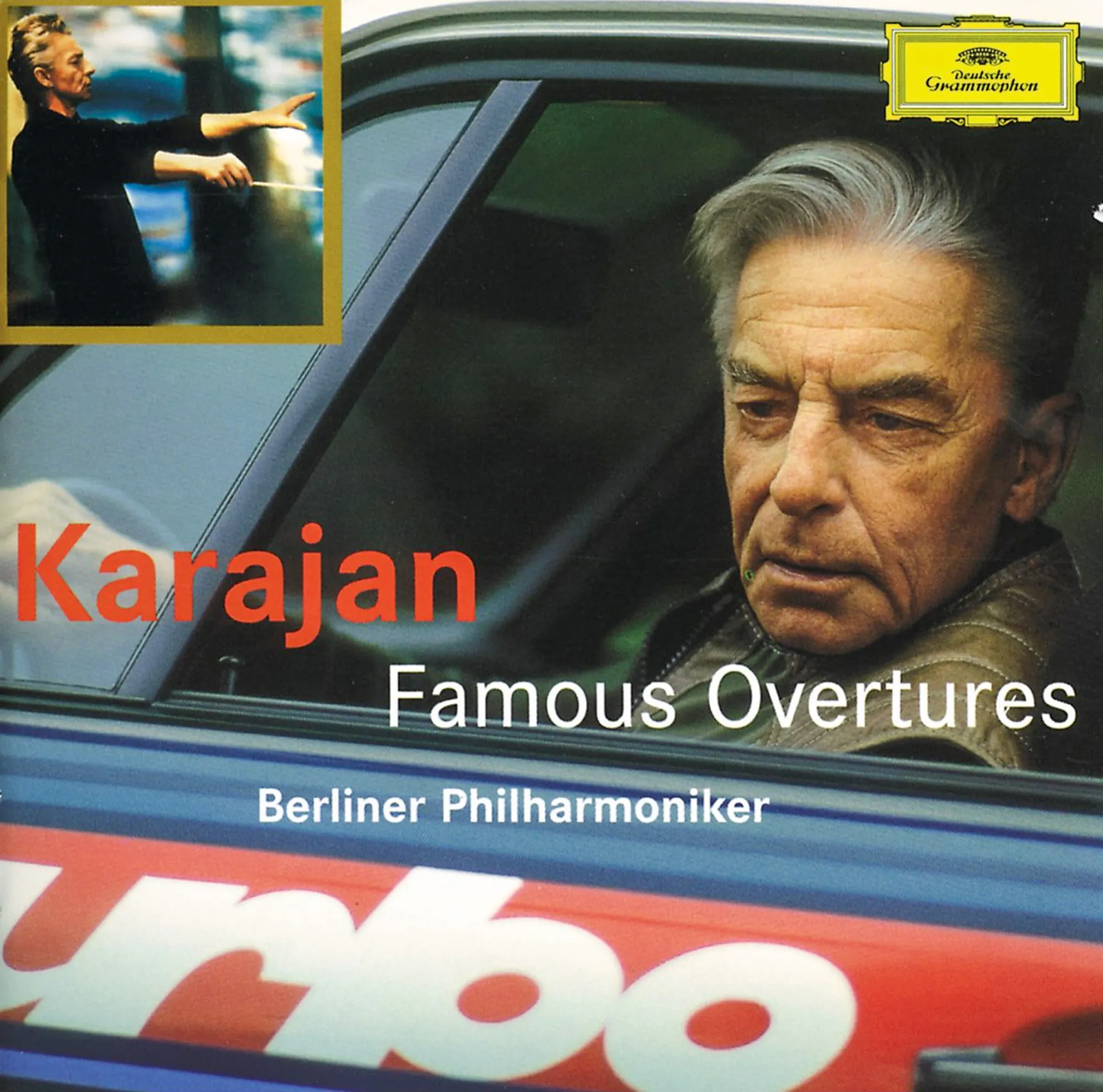
Von Karajan examines the placement of his custom 930’s rally lamps with Porsche personnel, before it got its famous paint job. Porsche Von Karajan kept the 930 spezial for a number of years, even featuring the car, with him at the wheel, on the cover of one of his best-selling albums, Famous Overtures with the Berlin Philharmonic .
It’s considered one of the most significant 930s ever made and was part of Porsche’s official collection after passing out of von Karajan’s hands. In amongst the Porsches were a handful of other Italian cars, and not just Ferraris. Von Karajan had a Lancia Stratos HF, in his favorite Indian Red, and late in life owned a 1988 Lancia Delta Integrale HF .
The Porsche 959 was one of the vehicles that defined the concept of a supercar. Development started in 1983, and the car featured adjustable ride height, anti-lock brakes, and run-flat Bridgestone tires, and it marked the first use of Kevlar aramid panels in a production automobile.
The 2849-cc flat-six had twin sequential turbochargers with an intercooler. While the cylinders were air-cooled, the six individual cylinder heads were liquid-cooled. Power totaled 450 hp at 6500 rpm, but with more boost the engine could produce another 200 hp, driving all four wheels through an electronically controlled AWD system.
Zero to 100 km/hr (62 mph) was just 3.6 seconds (including in wet conditions) with a top speed close to 200 mph. When the 959 got the green light, von Karajan was one of the first potential customers that Porsche contacted. By then the conductor was in his late 70s, though he was still physically active and mentally sharp.
An early production car was sent to von Karajan’s home for him to check out, with a crew from Germany’s national television network on hand. After taking his wife Eliette for a ride on the country roads surrounding their estate, he ordered one of the 292 examples to be made, again in Indian Red, but specifying dove gray cloth upholstery instead of the full leather interior that was standard—better seating grip when cornering hard.
In the completed television show, Karajan in Salzburg, upon completing his first test drive, you can hear von Karajan, who was also a pilot, say, “Unbelievable. I mean it’s not a car, it’s a plane.” As Eliette gets in the passenger seat when her husband prepares to take the 959 out again, she says, “It should be my present for Christmas, but he doesn’t dare to tell me the price of the car.
He said, ‘I’m not rich enough.’ I said he has to make more recordings.” The Porsche factory delivered the 959 directly to von Karajan at his winter home in St. Moritz, Switzerland. He kept it for about a year before selling it to his friend, fellow motoring enthusiast and socialite Prince Sadruddin Aga Khan, just prior to the great conductor’s death on July 16, 1989.
The supercar was a stylish coda to a life spent at the wheel of enjoyable machinery.
Article text via FreeNewsAPI. Rights remain with Hagerty.
Read on publisher site → Opens Hagerty in a new tab