Hubble Space Telescope Spots Dusty Spiral Galaxy: NGC 1827
Astronomers using the NASA/ESA Hubble Space Telescope have captured a new view of NGC 1827, an intermediate spiral galaxy seen edge-on in the constellation Columba. This Hubble image shows the edge-on,...
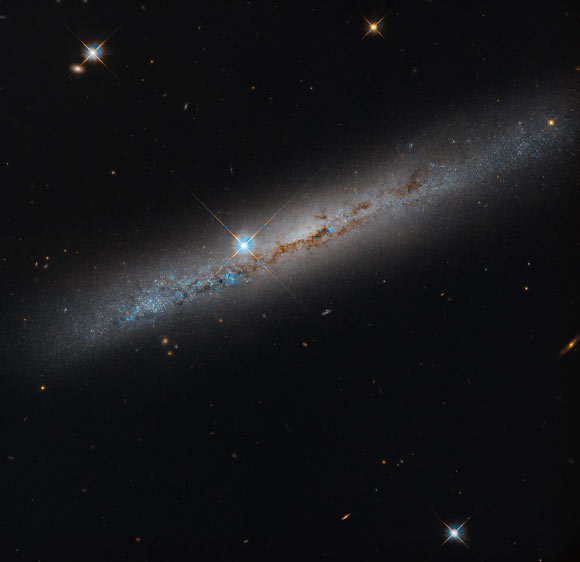
Astronomers using the NASA/ESA Hubble Space Telescope have captured a new view of NGC 1827, an intermediate spiral galaxy seen edge-on in the constellation Columba. This Hubble image shows the edge-on, intermediate spiral galaxy NGC 1827. Image credit: NASA / ESA / Michael Jones, California Institute of Technology / Gladys Kober, NASA / Catholic University of America.
NGC 1827 resides approximately 37 million light-years away from Earth in the southern constellation of Columba. This galaxy was discovered by the British astronomer John Herschel on November 28, 1837. Otherwise known as ESO 362-6, LEDA 16849 or IRAS 05083-3701, it belongs to the NGC 1792/1808 group of galaxies.
The new image of NGC 1827 was captured with Hubble’s Advanced Camera for Surveys (ACS) instrument. “The image reveals bright-blue regions along the galaxy’s disk dotted with dark dust lanes where new stars are likely forming,” the Hubble astronomers said in a statement . “A bright foreground star appears just to the left of the galaxy’s bright central bulge but is located between us and the galaxy.” “Its four diffraction spikes are the result of light bending around the internal supports that hold Hubble’s secondary mirror.” The image is part of a Hubble survey of 260 satellite galaxies orbiting 22 Milky Way-like host galaxies within about 32 million light-years of Earth.
The astronomers have observed 111 of them so far; the remaining 149 will need one orbit each. “Low-mass galaxies like the ones in this Hubble observing program provide a way to test the predictions of cosmological models on small scales, which struggle to match observations,” they explained.
“The data Hubble gathers will help us better understand and characterize the properties of low-mass galaxies in Milky Way-like systems, allowing researchers to refine cosmological models.”
Article text via FreeNewsAPI. Rights remain with Sci.News.
Read on publisher site → Opens Sci.News in a new tab