Johns Hopkins tests millirobots for targeted heart drug delivery
Engineers at Johns Hopkins University have developed magnetically guided millirobots for targeted delivery of drugs to heart tissues affected by infection. As News-Medical reports, the results of the work...
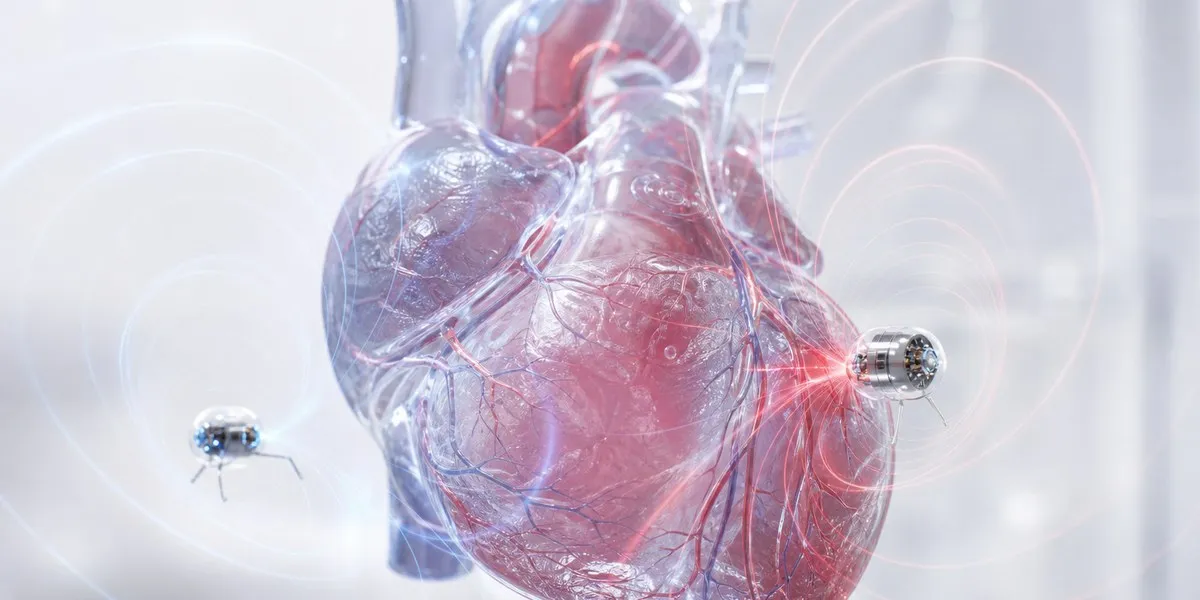
Engineers at Johns Hopkins University have developed magnetically guided millirobots for targeted delivery of drugs to heart tissues affected by infection. As News-Medical reports , the results of the work were published in the journal Advanced Materials Technologies. Two modules for antibiotic delivery The millirobots are about as wide as a pencil tip or a match head and as long as a grain of rice.
The system consists of two parts: a needle module attaches to heart tissue near the infection site and serves as a docking station, while the drug module delivers the antibiotic, magnetically connects to the first module, and gradually releases the medication. Both devices are wirelessly controlled by an external system of electromagnetic coils, whose operating principle is compared with MRI.
The robots have no batteries or motors of their own. According to the authors' concept, dividing the system into two small modules makes it possible to reach narrow areas of the body and replace the drug module for repeated administration of the medication. More current news is available on the UA.News Telegram channel Telegram .
Tests on models and tissues The researchers tested the system on heart models that imitate the human organ, as well as on pig heart tissues. According to their data, the robots moved smoothly, including against simulated blood flow. The next stage is expected to involve tests on more realistic models with muscle contractions and motion similar to a beating heart.
The technology is being developed primarily for the treatment of endocarditis, an infection of heart tissues. The article notes that about 50,000 people in the United States develop endocarditis each year, while intravenous antibiotic treatment usually lasts for weeks. The authors believe that targeted drug delivery could reduce the procedure to several hours or less than one day, but this assumption requires further research.
Article text via FreeNewsAPI. Rights remain with UA.NEWS.
Read on publisher site → Opens UA.NEWS in a new tab