Meet the Candidates: Mott Community College Board of Trustees — Andrew Watchorn
Andrew Watchorn is one of eight candidates vying for two open seats on Mott Community College Board of Trustees. Courtesy photo. FLINT, Michigan – Twelve minutes into our conversation, Andrew Watchorn says,...
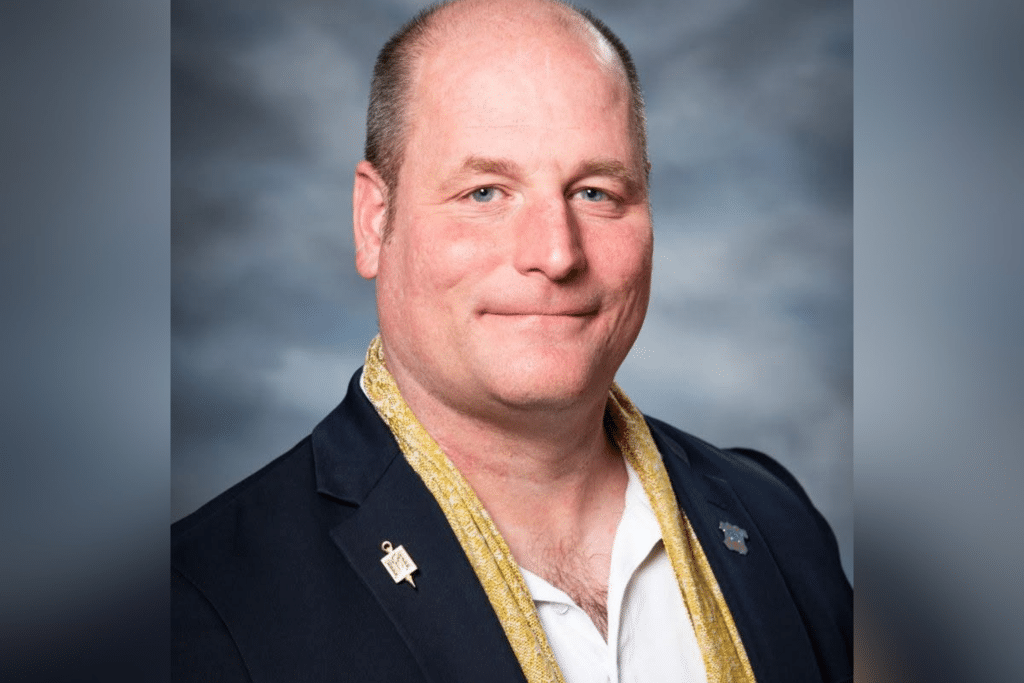
Andrew Watchorn is one of eight candidates vying for two open seats on Mott Community College Board of Trustees. Courtesy photo. FLINT, Michigan – Twelve minutes into our conversation, Andrew Watchorn says, smiling, that two musicians from the Flint Symphony Orchestra are staying at his house.
He’s also hosted a community orchestra from France that the Flint Institute of Music brought to town. He offers this at the start of our conversation at the Gloria P. Coles Flint Public Library as proof of something he never would have said as a teenager: “There’s too much to do here sometimes.” He says that, after leaving Flint — for Ann Arbor, Austin, Richmond, Boston and Chicago — and spending the better part of two decades finding his way back.
Now 51, he’s one of eight candidates running for two open seats on the Mott Community College Board of Trustees on Nov. 3, his second attempt after falling short in 2024. Born in Flint, Watchorn moved to Davison and graduated from Davison High School.
His mother worked at Kettering, and at a science fair they hosted, he won with a project he built in his basement that landed him a co-op at Delco Electronics. He kept that co-op through the University of Michigan, student-teaching at Central High School, and graduated with degrees in engineering physics and music education.
He explains that while he loved teaching, he didn’t want it to be his main job. So he joined National Instruments in Austin at the height of the dot-com bubble and spent 20 years helping universities like MIT, Virginia Tech, Michigan, and Kettering bring hands-on technology into their classrooms.
He insists the skills are the same ones “you’d use to teach a young person how to sing.” But Flint never left his mind. He started investing in the city in 2005, took a major ownership stake in Flint City T-Shirts in 2012, and bought a house that same year, when it had been basically empty.
He boasts that it hasn’t been empty since. A dressmaker, a shoemaker, and an urban fashion company have made it their home. Now, it’s an artist’s recording studio and a candle shop.
“If you have a good idea and the ability to make a space for people to have good ideas,” he says, “then good people will find you.” Good people or unicorns “that keep coming around me,” like employing several Mott Community College graduates at Flint City T-Shirts, many from its graphic design program.
So when Watchorn decided to leave Chicago, Mott was “one of the reasons that made it easy to come back.” He moved back to Flint in 2015, and in February 2020, he left National Instruments to start a master’s at Kettering, “not realizing that three weeks later everybody else was going to be leaving their jobs.” Today, Watchorn’s a lecturer there, working on a PhD in engineering education at Purdue University, and travels to Nigeria and Uganda once a year for engineering education work.
Watchorn’s campaign comes down to four words: affordable, excellent, safe, and thriving. Courtesy photo. So, when I ask what he learned from his 2024 loss, he points to timing.
Back then, he shares, the community hadn’t yet realized “that something was going on at Mott Community College.” Now he senses more interest on both sides of the aisle in “a return to some better time where there was good government.” As such, his campaign comes down to four words: affordable, excellent, safe, and thriving.
Affordable starts with who Mott serves. It’s “the first opportunity for many people in our community to attend an educational experience that is not mandatory.” At a high school choir concert’s senior night, he remembers that half of the college-bound seniors mentioned attending the community college.
That, he argues, means investing in students, pointing to Mott’s nearly $50 million endowment, far above the national median for community colleges, according to Data USA , which he says “allows Mott to keep its tuition low.” Excellent means credits that transfer cleanly to UM-Flint, Kettering, and anywhere else students go next, plus leadership that holds on to strong faculty.
To him, safe means no one in power “approaching you with a worldview that you may not believe in.” And because of that, the board “should be putting policies in place and enforcing them to hold the administration accountable for what they do.” Thriving means returning to increased enrollment and a college people want to engage with.
Watchorn claims that “a thriving institution is one that people want to invest in. One that people want to pass a millage for.” On the board itself, he’s specific. He’d strengthen the board’s ethics policy, which he says lets the chair alone decide whether a reported conflict is real.
“That cannot be considered best practice,” he says. He also wants trustees to respond to public comment so people “feel heard, even if you disagree with them.” He also wants a national search the next time Mott Community College hires a president, led by a search firm that brings the board candidates from across the country.
“They may have decided on the best candidate this last time,” he says. “But why limit the value of that candidate by saying, ‘Oh well, we just didn’t consider anybody else,’ right? That actually diminishes that person’s power and ability.” He’s willing to give the current board credit, too.
“I am going to applaud the board when it does the right thing,” he says. But rebuilding trust has “got to start with doing the right things,” beginning with elected officials “doing the public’s business in public.” Then there are the problems the board didn’t create. Fewer high school graduates because today’s seniors were born just after the 2008 downturn, and in higher education, “the winners keep winning” as the biggest universities grow.
“There is nobody that can offer the quality of education that Mott Community College does at the price per credit hour that it does.” Courtesy photo. He wouldn’t take dual enrollment off the table; a bunch of his friends have sent their kids to Genesee Early College and Mott Middle College, and they’ve been “incredibly successful.” But for Watchorn, Mott’s real answer is to make its value plain.
“There is nobody that can offer the quality of education that Mott Community College does at the price per credit hour that it does.” And there’s AI, which he says even the people studying it deeply aren’t sure about yet. Robots will take on more hands-on work, he predicts, but AI “still cannot make judgment.” On top of that, he wants the college to produce informed citizens, not just employees, through the broad curriculum accreditation requires, from English to music.
“I want my plumber to be an informed citizen,” he expresses. “I want them to enjoy life the same way that people who go to Yale do, if that’s what they want to do.” Years on the Flint Public Library’s finance committee shaped how he approaches the budget. He explains that the library tightened its belt after spinning off from the school district during a major downturn.
Now, financially sound, it weighs whether to save, spend, or open more days a week. Mott faces similar choices, from faculty pay to new buildings to scholarships. “It’s all about choice-making.
And I’ve been doing that in this community for over a decade.” But between teaching, earning a PhD, board membership, and community work, there’s a perception that Watchorn might be too busy for the board. “I will cut some things,” he admits. If elected, he says he’d likely step down from the Flint Public Library’s finance committee and as treasurer of the Flint Institute of Arts Founders Society.
And while he owns Flint City T-Shirts, he doesn’t run it. He jokes, before giving me permission to print it, that “sometimes they don’t want me there.” Yet at the end of our conversation, I have to ask a personal question about his love for music and how it relates to running for board trustee.
He describes a lesson he learned long ago: comparing the perfect studio recording of a Paul Simon song with a live performance in South Africa, which he calls “a different thing.” Music, he says, isn’t just “the notes and the rhythms,” and neither is a college. “Mott is not its budget, and it is not its numbers only.” He says context is what his music degree taught him most, and he brings that to the board, too.
People might think of a board as “just all rational, but it’s not.” Keep “the rational and the human together,” and something can tip “over into spectacular, and you didn’t even know it could be that good.” “That’s what I want for this community, and that’s what I want for the students of Mott.” Hearing that, I think back to a story he told me earlier, about a group of Virginia Tech students he worked with in the early 2000s who went on to build autonomous vehicles and were later acquired by another company.
“Now that’s the unicorn,” he’d said. “Although unicorns keep coming around me for some reason.” So I tell him he seems to attract them. “Put that in the article,” he says.
“My mother will love it.”
Article text via FreeNewsAPI. Rights remain with Flintside.
Read on publisher site → Opens Flintside in a new tab