Microsoft Considers Cartridges Instead of Blu-ray Disc for Project Helix Consoles
Microsoft plans to replace Blu-ray drives with single cartridges for the three versions of Project Helix, with the ability to run the same media on both desktop and portable consoles.
Maxim Boldson HARDWARE October 18 2026 Views: 39 Rumors of Microsoft's possible abandonment of traditional Blu-ray optical drives arose amid the publication of new job postings for the gaming division responsible for physical release management, which completely omits any mention of laser discs.
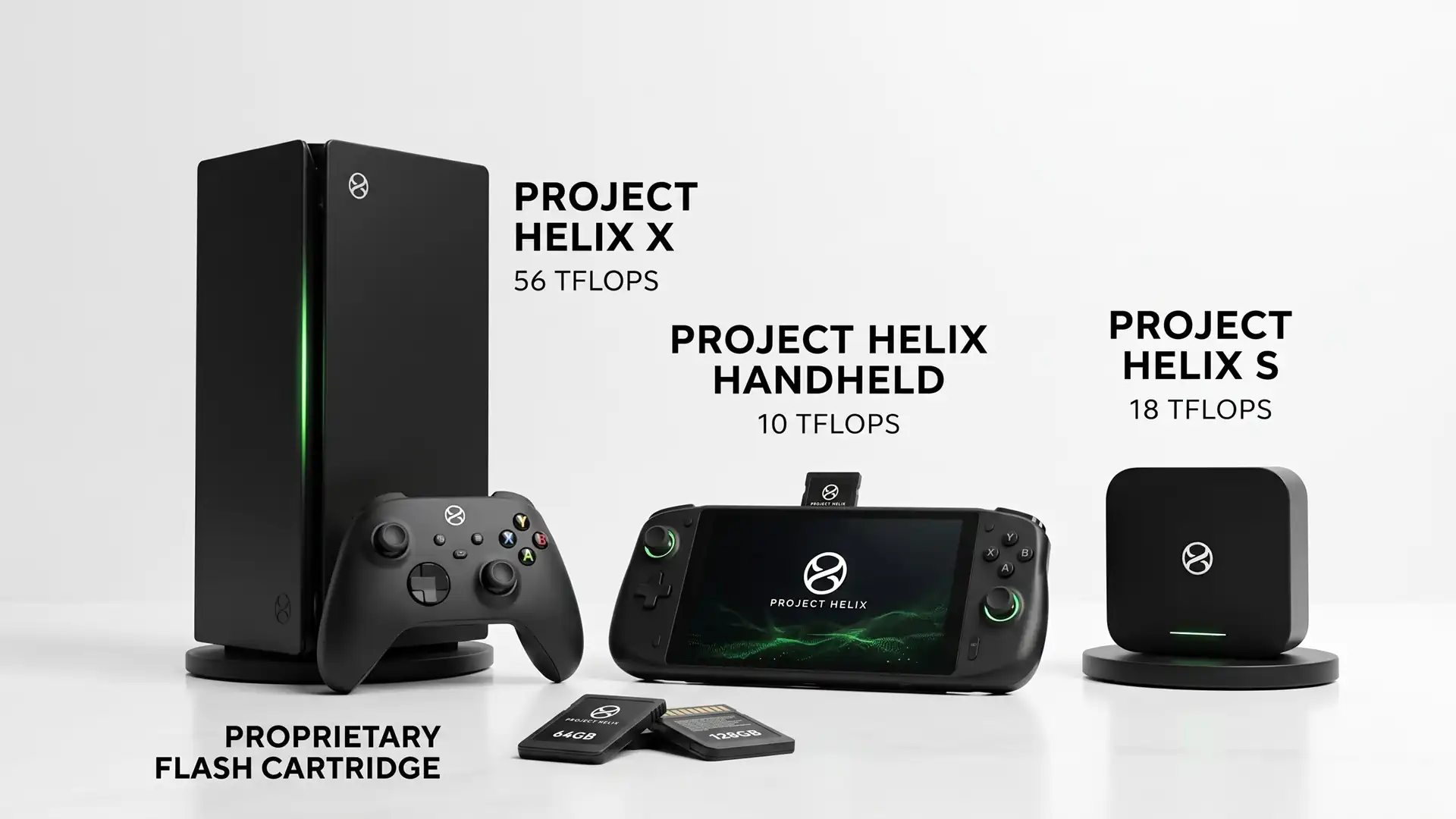
Analysts cite the main reason for the revision of the physical format as the global downsizing of specialized drive and disc factories, making continued production of traditional disc drives economically unviable. The company's engineers are seriously considering switching to removable solid-state flash drives similar to those used in Nintendo Switch cartridges or a proprietary standard.
Such a transformation would preserve retail physical releases for collectors and users without high-speed internet access, freeing the company from slow read speeds and regular licensing fees to third-party Blu-ray standard patent holders. The removal of disc drives aligns directly with the development plans for the Project Helix hardware line, which will be released in three different tiers based on AMD's custom semiconductor architecture, whose silicon chips have already successfully passed the tape-out stage.
The flagship desktop system, Project Helix X, targets 56 teraflops of graphics performance, while the GPU of the competing PlayStation 6 console delivers approximately 40 teraflops of computing power. The entry-level home model, Project Helix S, targets approximately 18 teraflops of computing power, maintaining the continuity of the generational divide.
The third element will be the portable Project Helix Handheld, with 10 teraflops of computing power for battery life. The introduction of a single physical slot solves a key issue with the previous generation, where the base Xbox Series S console was released exclusively without a disc drive and did not support physical Xbox Series X disc-based titles.
Now, a single cartridge from the Project Helix X desktop system can be directly inserted into the Project Helix Handheld console or played on the base Project Helix S. The main obstacle to the mass adoption of the new format remains the physical size of the drives and the cost of semiconductor memory.
Modern game releases require 64GB and 128GB solid-state drives, but a standard drive Ultra A 100GB HD Blu-ray disc costs a publisher just $2-$3 to replicate. Against the backdrop of high market prices for fast NAND flash memory, the production of a single 64GB cartridge costs $12-$16, while a 128GB drive can cost $20-$25 per unit.
To maintain the standard retail price of games, the corporation will have to find a balance between subsidizing high-capacity cartridges and releasing basic 32-64GB media, which require downloading high-resolution textures from the network. At the same time, the compact dimensions of the slot allow the card reader to be placed in the thin case of a portable console, where a traditional disc drive physically cannot fit, and the absence of rotating components completely eliminates noise when reading data.
DISCUSSION CENTER @GameGPU_com Join the discussion, share your benchmark results, and debate hardware performance in X. Discuss on X
Article text via FreeNewsAPI. Rights remain with GameGPU.
Read on publisher site → Opens GameGPU in a new tab