MIT tests magnetic implants in three people with amputations — News-Medical
Researchers at the Massachusetts Institute of Technology tested a system of tiny magnetic beads implanted in muscles to more accurately track their movements. The study involved three people with below-knee...
Researchers at the Massachusetts Institute of Technology tested a system of tiny magnetic beads implanted in muscles to more accurately track their movements. The study involved three people with below-knee amputations. As News-Medical reports , the technology could help improve control of robotic prostheses.
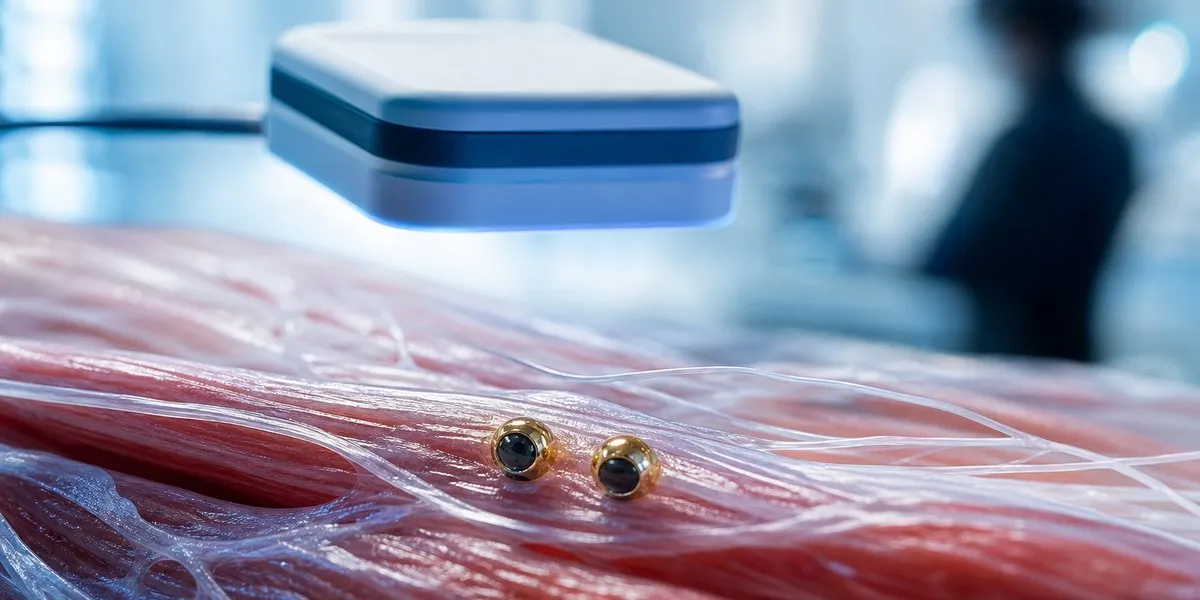
How magnetic tracking works The method, called magnetomicrometry, involves implanting a pair of magnets into a muscle. When the muscle contracts or stretches, external sensors placed on the skin detect the change in distance between the magnets. This makes it possible to calculate the muscle’s length and the speed of its movement.
Each bead is 3 millimeters in diameter, approximately the size of a sesame seed. The magnets are made of a neodymium-iron-boron alloy and coated with gold and the polymer parylene C for biocompatibility. The signal can be read from a depth of up to 6 centimeters from the skin’s surface using a special external sensor.
More current news is available on the UA.News Telegram channel Telegram . Comparison with electrodes Participants had magnets implanted in up to four muscles associated with the ankle joint. Electrodes were also implanted in the same muscles, making it possible to compare three methods of reading signals: magnetomicrometry, electromyography with implanted electrodes, and electromyography with electrodes on the skin’s surface.
During the experiments, participants did not wear prostheses and moved a cursor on a screen using muscle signals. According to the authors, the results of this virtual task indicate that the magnetic approach may provide more precise and stable control. The researchers are conducting a broader study to assess how effectively people will be able to control prostheses using data from magnetic implants.
The work was published in the journal Nature Sensors.
Article text via FreeNewsAPI. Rights remain with UA.NEWS.
Read on publisher site → Opens UA.NEWS in a new tab