Recognizing Cutaneous Sarcoidosis Across Diverse Skin Tones
THE COMPARISON:A. Cutaneous sarcoidosis on the face with sparing of the nasal skin in a 43-year-old Black woman with extensive biopsy-proven cutaneous sarcoidosis.B. Cutaneous sarcoidosis on the face in a...
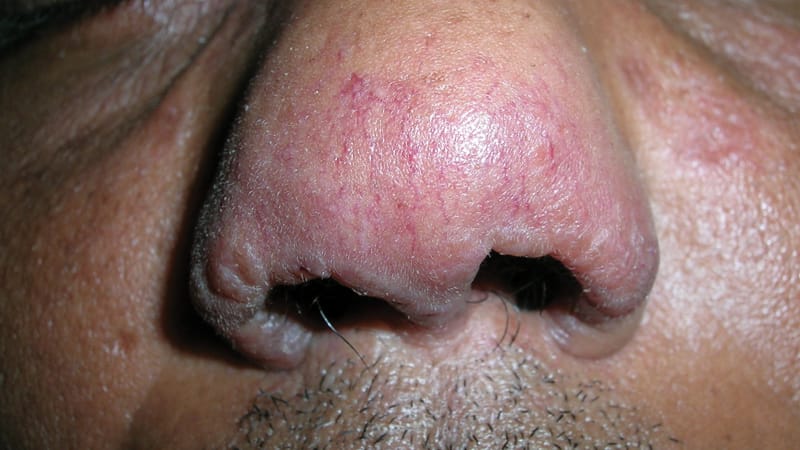
THE COMPARISON: A. Cutaneous sarcoidosis on the face with sparing of the nasal skin in a 43-year-old Black woman with extensive biopsy-proven cutaneous sarcoidosis. B.
Cutaneous sarcoidosis on the face in a 48-year-old Black man with prominent nasal alar involvement. C. Biopsy-proven cutaneous sarcoidosis on the legs of a 76-year-old White man with hilar adenopathy.
Sarcoidosis is an inflammatory condition in which 90% of patients have noncaseating granulomas in the lungs or thoracic lymph nodes of unknown etiology. [1,2] Sarcoidosis can be multisystemic, involving other internal organs as well as the nervous system, eyes, joints, and skin. [1,3] Cutaneous sarcoidosis is the most common extrathoracic manifestation, affecting about one-third of patients with sarcoidosis. [3] Cutaneous lesions can appear anywhere on the body and are categorized as sarcoidosis-specific or nonspecific. [3,4] On histopathologic examination, sarcoidosis-specific skin lesions include noncaseating granulomas, whereas nonspecific lesions—most commonly erythema nodosum —show nongranulomatous inflammation. [3] Sarcoidosis-specific lesions vary in presentation and can manifest anywhere on the body, most commonly on the arms, face, and trunk. [4] Papule-predominant sarcoidosis is the most common manifestation.
Lupus pernio refers to violaceous papules along the alar rim of the nose. When the papules have a more chronic presentation, they may progress to plaques. Subcutaneous sarcoidosis manifests as deep, poorly demarcated nodules.
Sarcoidosis skin lesions also can manifest on preexisting tattoos or scars. [4] Epidemiology The prevalence of sarcoidosis varies by age, race, sex, and geographic location. [5] In the United States, the overall prevalence is 60 per 100,000 individuals, with a prevalence of 19 per 100,000 in Asian Americans and 140 per 100,000 in Black Americans, with other reported racial groups falling in between.
Sarcoidosis is more prevalent in women than in men, and women usually are diagnosed later in life. [5] Overall, Black women comprise the most frequently affected demographic. [2,5] Black patients also are more likely to develop cutaneous sarcoidosis. [5] First-degree relatives of Black patients with sarcoidosis have a 3-fold increased risk for developing this condition. [2,6] Key Clinical Features Erythema associated with cutaneous sarcoidosis is more difficult to appreciate in darker skin tones and may appear brown or purple. [4,5] Less common nonspecific findings, such as calcifications, prurigo, and nail clubbing, have been reported in Black patients. [7] Sarcoidosis-specific lesions are more common in patients with skin of color and can manifest as pink, red, purple, brown, or even gray. [5] Scarring associated with plaques in patients with darker skin tones may be hypopigmented instead of hyperpigmented. [4,7] Lupus pernio most commonly occurs in Black women. [7] Women and Black patients are more likely to develop ulcerative sarcoid lesions. [7] Worth Noting When sarcoidosis affects the scalp, it most often manifests as cicatricial alopecia. [4] Although erythema nodosum is the most common nonspecific finding in sarcoidosis, it is less common in Black patients vs White patients. [7] The severity of cutaneous manifestations is not used to evaluate the extent of sarcoidosis, as patients can have severe systemic disease without skin involvement. [4] It has been thought that cutaneous sarcoidosis occurs due to upregulation of interferon ɣ, interleukin 12, and tumor necrosis factor, and recent findings include involvement of the Janus kinase–signal transducers and activators of transcription pathway and granulocyte-macrophage colony-stimulating factor in the inflammatory cascade. [4] Topical or intralesional corticosteroids are the first-line therapy for cutaneous sarcoidosis; however, oral corticosteroids, hydroxychloroquine, and steroid-sparing agents can be used in systemic or refractory cases. [4] Drug-induced sarcoidosis has been reported in patients taking interleukin 1 receptor antagonists and tumor necrosis factor ɑ inhibitors, which are used in hidradenitis suppurativa treatment. [8,9] Hidradenitis suppurativa has been associated with sarcoidosis, possibly due to inflammation secondary to chronic infection, particularly human herpesvirus. [10] Health Disparity Highlight Pharmacotherapy for pulmonary sarcoidosis often includes antifibrotic drugs, which can be financially burdensome especially for those patients who have low income or are underinsured. [11] Patients of lower income or uninsured status who have sarcoidosis often have reduced lung function with increased disease progression, likely due to the financial barrier of accessing adequate medication. [11] Granuloma formation in sarcoidosis is believed to be T-cell dependent, and Black patients have immense human leukocyte antigens type II diversity compared to White patients. [4,7] The HLA-DPB1 gene, thought to harbor sarcoidosis susceptibility alleles, is commonly found in African American patients with sarcoidosis. [12,13] In addition, Black patients with sarcoidosis are more likely to be diagnosed in more advanced disease stages. [11] This is accompanied by increased hospitalization rates, increased systemic organ involvement, and increased mortality. [11] Black patients may be prescribed higher doses of corticosteroids, which is associated with a decrease in health-related quality of life. [11,14] Biological, environmental, and social differences between genders modify the presentation and treatment of sarcoidosis.
Although female patients are more likely to develop sarcoidosis, male patients often present with more advanced disease on radiography. Despite this nuance, female patients present with worse outcomes, lower health-related quality of life, and more hospitalizations. Curiously, male patients are more likely to be prescribed disease-modifying medications.
Although there are apparent disparities, determinants of health in sarcoidosis are incompletely explained. [11]
Article text via FreeNewsAPI. Rights remain with Medscape.
Read on publisher site → Opens Medscape in a new tab