The road to self-driving laboratories in industry
In this issue, we focus on the development of self-driving laboratories for the autonomous synthesis of molecules and materials, with a particular focus on industrial considerations and applications.
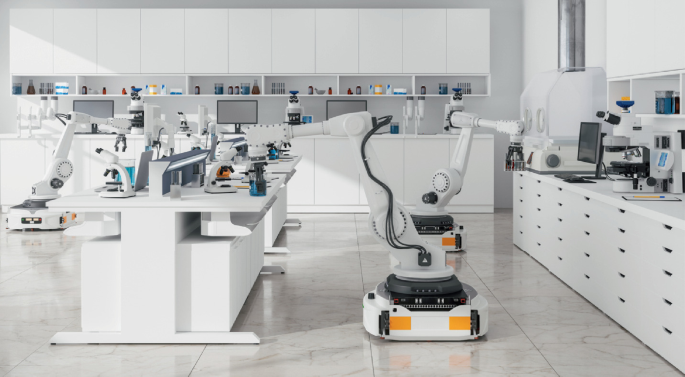
In this issue, we focus on the development of self-driving laboratories for the autonomous synthesis of molecules and materials, with a particular focus on industrial considerations and applications. Self-driving laboratories, which combine robotics, automation and artificial intelligence (AI) to autonomously plan and run experiments, are being used to accelerate research.
Moving this technology from academic proof of concept to industrial practice, however, can be challenging. This issue of Nature Synthesis brings together researchers working on developing self-driving laboratories to autonomously explore chemical space and accelerate the synthesis of molecules and materials.
In particular, the viewpoint of industrial researchers working all over the world to advance this technology is highlighted, with input from researchers at: AbbVie, AstraZeneca, Bristol Myers Squibb, Center for the Transformation of Chemistry, China Energy Investment Corporation, Eli Lilly and Company, eN-RAMPS, Genentech, NVIDIA, Samsung Advanced Institute of Technology, Takeda Pharmaceutical Company, and Zoetis.
Credit: onurdongel / Getty Images A Perspective by Meenesh Singh and co-workers brings together industrial researchers from companies working on biopharmaceutical research and discusses the use of self-driving laboratories for biopharmaceutical discovery and development. Recent industrial applications in solubility screening, solid-form characterization, electrochemical synthesis and lipid nanoparticle formulation are discussed, with an eye towards a future in which continuously learning, data-driven laboratories become foundational infrastructure for improving reproducibility across the biopharmaceutical industry as well as accelerating drug discovery and development.
Related to this goal, a Research Highlight in this issue based on work by Youxiang Wang, Qiao Jin and co-workers describes an active-learning platform, termed PolyCAML, that couples automated synthesis, high-throughput characterization, and machine learning to accelerate the discovery of antifungal, peptide-mimicking copolymers.
On the topic of using self-driving laboratories for discovery, recent work published in Nature Synthesis from researchers in academia describes some of the advances in robotics and AI for reaction screening which hold promise for discovering new reactions and making self-driving laboratories more affordable and accessible.
For example, an Article by Bartosz Grzybowski and co-workers reports the discovery of a pseudo-seven-component transformation based on the century-old Biginelli reaction by using a robotic platform to examine chemical reactivity across multidimensional ‘hyperspaces’ of conditions.
Continue reading
Watch a short ad to unlock the full article
The rest stays locked if you skip or close the ad early.
As discussed in a News & Views article by Theodore Tyrikos-Ergas and Eric Sletten, this approach to exploring reaction space transforms automated synthesis from an optimization tool into a discovery engine. Another Article , this time by Timothy Noël and co-workers, describes RoboChem-Flex, a modular self-driving laboratory platform using in-house-built hardware and a flexible Python-based software framework.
The versatility of this customizable platform is demonstrated by the breadth of reactions it can be used for, including photocatalysis, biocatalysis, thermal cross-couplings and enantioselective catalysis. Perhaps most importantly, the relative affordability of this platform at around US$5,000 offers to help democratize autonomous chemical experimentation by making self-driving laboratories more accessible.
Translating laboratory-scale results from smaller to larger scales of development (for example, from high-throughput discovery up to large-scale industrial application) is often challenging. In a Comment article, Xiaonan Wang and Zhihao Wang make the case that self-driving laboratories should generate scale-aware candidate landscapes that link laboratory-scale experimental results to representative-device and process-development stages, distinguishing candidate regions as either validated for next-scale testing, excluded by industrial constraints, or requiring targeted exploration to reduce scale-dependent uncertainty.
Furthermore, a Comment article by Brandon Sutherland, Varinia Bernales and Alán Aspuru-Guzik explains that the pace of materials discovery is increasingly determined by how quickly candidate materials can be made, characterized, and validated at scales relevant to real applications.
However, maintaining progress in materials discovery will require not only technical advances but also a coordinated ecosystem of standards, shared data, and translational infrastructure across sectors. Importantly, faster synthesis, better decisions under uncertainty, and reliable translation from laboratory to manufacturing all depend on infrastructure that no single laboratory, company, or agency can build alone.
As we embrace these exciting autonomous systems, one of the key considerations that must be taken is safety. Industrial self-driving laboratories need more than safe robots and instruments; they need an autonomy safety harness that defines how AI-generated intent becomes executable experiments, monitored actions and trustworthy evidence for downstream research and development.
This is the key message delivered in a Comment article by Linjiang Chen, Xiaobo Li, Quan Lin and Jun Jiang. A Q&A with Nessa Carson considers the challenges of implementing autonomous laboratories and digital chemistry in industry. The benefits and difficulties of increasing laboratory automation are discussed, alongside the importance of developing multidisciplinary teams with complementary expertise in chemistry, data science and engineering.
The need for robust data management, standardized infrastructure and strategic implementation to enable the integration of emerging technologies into existing industrial workflows is also highlighted. A Q&A with Youn-Suk Choi explores the development and application of self-driving laboratories for chemical research and materials discovery in industry.
The motivations for adopting AI-driven robotics, including the need to accelerate innovation and address workforce constraints, are discussed alongside the distinct requirements of industrial systems, including scalability, flexibility, compatibility and generality. The discussion also considers collaboration between academia and industry, human–AI cooperation and the development of technology standardization and modularization to facilitate wider adoption of self-driving laboratories.
The development of self-driving laboratories is growing rapidly, and the adoption of these technologies is changing the landscape of how research is conducted in academia and industry 1 . Many researchers have been drawn to the possible benefits of integrating robotics and AI into the synthesis of molecules and materials 2 and investment into self-driving laboratories is prevalent in industry, with a wave of start-ups and large, established companies embracing AI and robotics for chemical experiments 3 .
At Nature Synthesis , we are excited to see how this field will continue to grow and the advances that we can expect in the future.
Article text via FreeNewsAPI. Rights remain with Nature.
Read on publisher site → Opens Nature in a new tab