VSCO Takes On Lightroom With First Native Mac Editing App
VSCO released VSCO Studio Pro Desktop, its first native macOS photo editor, on Tuesday, following the iOS version launched earlier this year. The app is a free download for Apple Silicon Macs, with full features requiring a VSCO Pro membership at $5 a month or $60 a year, or a VSCO One subscription at about $500 annually. It supports RAW files from more than 800 cameras across 20 brands, offers over 200 presets and can batch-edit up to 500 images at once, with direct export to VSCO Galleries. Masking, curves and spot removal are not yet available. VSCO says it does not train its own AI models on user images.
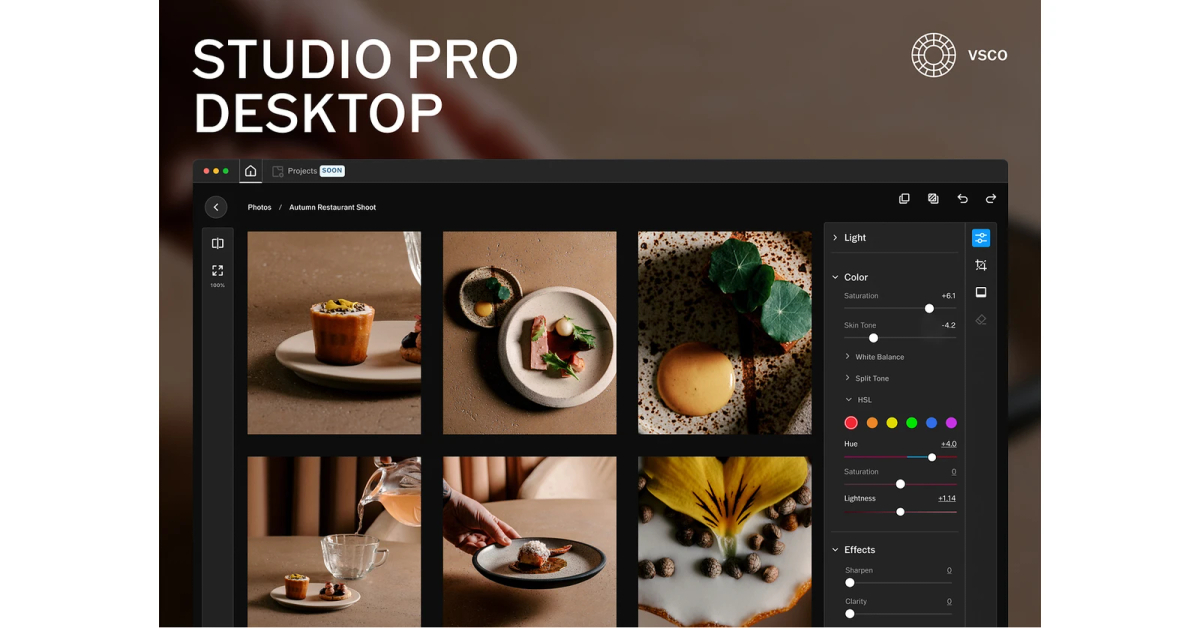
VSCO released its first native macOS photo editor on Tuesday, moving the preset-driven photography brand onto the desktop and into more direct competition with Adobe's Lightroom. The app, VSCO Studio Pro Desktop, follows the iOS version of Studio Pro that launched earlier this year.
It is a free download for Macs running on Apple Silicon, with full access tied to a paid membership. Neither the desktop nor the mobile version is available on Windows or Android; the San Francisco-based company says it intends to port the software to those platforms later. VSCO is positioning the release as a way to keep photographers inside its own pipeline rather than sending them to separate programs.
The desktop client plugs into VSCO Galleries, the company's client-delivery service, so finished images can be published at full resolution without a separate export-and-upload step. It also connects to a wider set of services VSCO has rolled out over the past year, including Workspace, a customer relationship management tool for contracts, booking and scheduling, and Sites, a portfolio website builder.
Bundling those products is central to the strategy. A VSCO One subscription, which covers Studio Pro, extra presets, Workspace, Galleries and Sites, runs about $500 a year. Photographers who want only the Studio Pro mobile and desktop apps can buy a VSCO Pro membership at $5 a month, or $60 annually.
A free tier exists, but several tools sit behind the paywall. "We've got to keep giving them more bricks to build upon their own personal, creative journey—not just their creative journey, but also help them build a career," Chief Executive Eric Wittman said of the company's users.
The company is betting that its preset library, a signature of the VSCO brand, translates into a desktop workflow. More than 200 presets are included, among them film-inspired looks modeled on Kodak Portra, Kodachrome, Fujifilm Velvia and Kodak Tri-X. An exclusive preset called IOE1 Pro was developed with photographer Joe Greer.
Users can adjust the strength, color, tone and contrast of any look. Wittman said three-quarters of VSCO Pro members have used the company's presets in the past six months, and that those looks now live on the desktop as part of a single chain running from camera to client delivery.
On the technical side, the app pairs Apple's Core Image RAW processing with VSCO's own Reflex engine, which handles presets and editing adjustments. It reads RAW files from more than 800 cameras across 20 brands, and imports from Apple Photos, local folders, SD cards and external drives.
Photographers can choose to edit files in place or copy them to another location, and keyboard shortcuts mirror those in rival editors to shorten the learning curve. The headline capability is batch editing, which can apply a preset or adjustment to as many as 500 images at once, with changes rendered across the selection in real time while the original files stay untouched.
Exports can be handled singly or in batches, with control over file name, format, resolution and compression, plus resizing presets for web, social media and client delivery. The editing panel covers exposure, contrast, fade, highlights, shadows, whites, blacks, skin tone, temperature, tint, hue, saturation, lightness, sharpening, clarity, vignetting and grain, the last with separate controls for strength, size and color.
Feature VSCO Studio Pro Desktop Platform macOS, Apple Silicon Price Free download; VSCO Pro at $5/month or $60/year; VSCO One about $500/year RAW support 800+ cameras, 20 brands Presets 200+, including IOE1 Pro with Joe Greer Batch editing Up to 500 images at once Delivery Direct export to VSCO Galleries Note: Pricing and specifications as announced by VSCO.
Even so, the app does not yet match Lightroom feature for feature. Masking, curves and a spot-removal tool are listed as coming soon, along with bloom and halation effects. Organizational tools are also in development, including projects for grouping photos and culling features that let users rate images with stars and mark them as accepted or rejected.
Kyle Hale, a senior product manager at VSCO, said the app is designed to cover roughly 70 percent of what photographers need for desktop editing, with the remainder arriving through regular updates. He said he does not expect full parity with Lightroom by the first quarter of 2027 but expects the software to carry the core of what competing programs offer.
"We want to be simple, intentionally, but we want to be powerful with our tools," Hale said. The release lands as Adobe and other creative-software makers push generative AI deeper into their editing suites. VSCO is charting a narrower course: it uses AI and machine-learning models in some tools, including the forthcoming erase and retouch functions, and draws on third-party models such as those from Black Forest Labs, but says it does not train its own models on images users post to the app and has agreements barring outside providers from training on its user data.
"Generative AI, or if you're replacing the photographer—like what you're seeing with what Meta is doing, what Adobe's doing, like almost every other company is doing—we are not doing that," Wittman said. "We stand by and champion photographers first and foremost, and that's not going to change." For VSCO, the desktop app is a test of whether loyalty built on mobile presets can be converted into a paid professional workflow.
Subscription revenue from working photographers is more durable than one-off consumer purchases, and owning the delivery step gives the company a reason to keep users from drifting to Adobe. The missing masking and curve tools, however, mean the app is likely to serve as a second editor for many professionals rather than a full replacement in its first year.
For Adobe, the immediate threat is limited, given Lightroom's deeper toolset and its hold on professional workflows. The competitive pressure is more likely to show up in pricing and in how aggressively VSCO bundles services around its editing software. VSCO has not disclosed subscriber numbers or revenue targets for the desktop launch.
Once added, BigGo Finance appears first in Google Search Top Stories, so you get the broadest, most up-to-the-minute, and most comprehensive global financial news first. Add preferred source
Article text via FreeNewsAPI. Rights remain with BigGo Finance.
Read on publisher site → Opens BigGo Finance in a new tab