Canada’s assisted dying reversal provides hope for Europe
Canada has seemingly decided to stop sliding down the slippery slope of assisted dying. On Wednesday, the country’s Justice Minister, Sean Fraser, revealed that the Liberal government would be indefinitely suspending its plan to legalise assisted dying for individuals whose only condition is mental. Before this, legislation had been passed which meant that, from March [...]Read More...
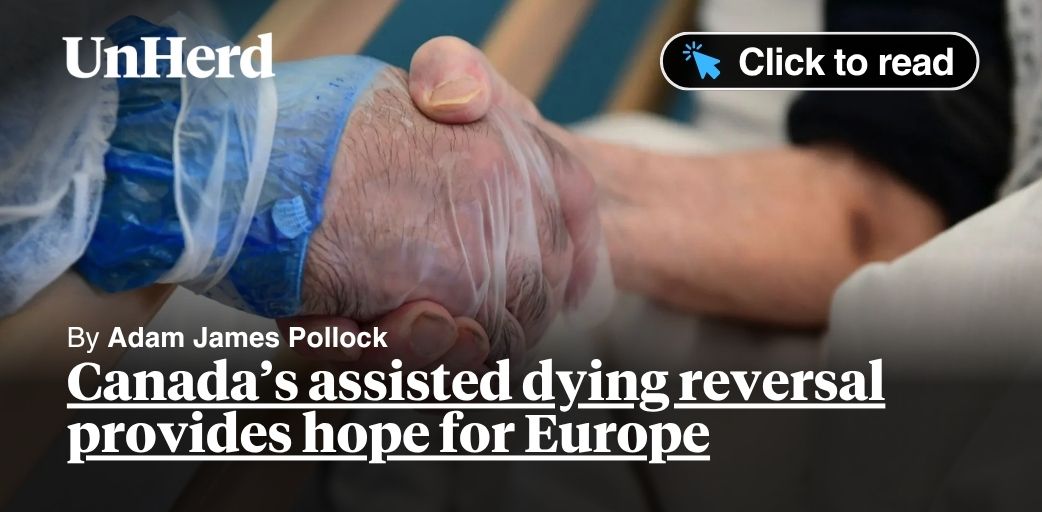
Canada has seemingly decided to stop sliding down the slippery slope of assisted dying. On Wednesday, the country’s Justice Minister, Sean Fraser, revealed that the Liberal government would be indefinitely suspending its plan to legalize assisted dying for individuals whose only condition is mental.
Before this, legislation had been passed which meant that, from March of next year, Canadians could apply to end their lives solely on the basis of mental illness. This law has now been shelved, with Fraser stating that the government has decided there is no medical consensus on when mental illnesses become incurable or untreatable, and that subsequently it would be impossible to discern in which circumstances individuals could be allowed to end their lives.
Psychiatrists had repeatedly been making this point, including earlier this year to a parliamentary committee , conveying that it is not possible to prognosticate on mental illness. At long last, the government appears to agree. Yet since 2021, people can apply to end their lives in Canada even if their death is considered to be “reasonably foreseeable”, meaning that many people with lifelong conditions which are not considered terminal, such as multiple sclerosis, can die by euthanasia.
This seems to reinforce the precedent that has long been put forward — whether implicitly or explicitly — by those who advocate for assisted dying, that the lives of disabled people simply have less value than their able-bodied counterparts. This two-tiered society has been evident in Canada for several years now.
Continue reading
Watch a short ad to unlock the full article
The rest stays locked if you skip or close the ad early.
Christine Gauthier, the Canadian Paralympian and army veteran, asked for state assistance in making her home more accessible through the installation of a wheelchair lift. Instead, she was offered euthanasia. Roger Foley, who has a degenerative neurological condition and remains in hospital, has repeatedly attempted to access self-directed home care, yet he is continually told by hospital staff that his only real options are to put up with his limited care or end his life.
There are countless other examples. The solution, which the Canadian government has finally taken its first steps towards, is not widening the scope for people to die, but instead providing people with the requisite care to live as meaningful and dignified a life as possible. Disability campaigners have been highlighting this plight in Canada for years, and it is one that has been echoed in great detail in Britain over recent months.
This year alone, legislation which would have legalized assisted dying in England, Wales and Scotland have all been rejected , in large part due to the worries of disabled people that they would essentially develop a duty to die. Legislators including Baronesses Grey-Thompson and Campbell , as well as Lord Shinkwin , revealed how they are frequently treated as second-class citizens due to their disabilities, and how this would translate to an increased vulnerability under an assisted dying program.
Hopefully, Canada’s change in direction will inspire other countries where assisted dying for mental illness is already legal to follow suit. In the Netherlands, for example, there have already been tragedies where lives have been ended when the individual’s mental-health condition could have been treatable, such as the case of an autistic boy between the ages of 16 and 18 who was euthanized following a failed suicide attempt, with the justification being that he was suffering mentally because of his autism.
This is precisely the kind of horrific case Canada has just avoided. The Netherlands could, and should, avail of this shift in medical and legislative viewpoint and repeal its legislation. Canada has taken the right first step in ensuring that people with serious illnesses or conditions — mental or physical — are not disproportionately adversely affected by assisted dying laws.
The next step back up the slippery slope is to reverse the other recent expansion of the law that allowed those for whom death is not reasonably foreseeable to end their lives. Assisted dying laws that were initially billed as being the exception to the rule have rapidly become the status quo, and any government that seriously cares about its citizens should seek to stamp this out.
Adam James Pollock is a writer and photographer, and the author of Sustenance .
Article text via FreeNewsAPI. Rights remain with UnHerd.
Read on publisher site → Opens UnHerd in a new tab